Labels

Showing posts with label Vietnam. Show all posts

Friday, 16 February 2024

French Indo-China - Dinassaut Commando Raid on Gian Khau 1948.


Background
We tend to think of the French position in Indochina as “a losing-hand”, that wasn’t always so. Following the post war reoccupation, the French pacified most of Indochina more or less. The Viet Minh found it hard to operate outside of their strongholds, in the face of superior French firepower and aggression. Only after the fall of China to Mao’s communist forces, did the Viet Minh have a safe-havens in to train and equip. 

Dinassaut Commandos

Today’s game is set in this earlier period and is a French Dinassaut raid on a village, used by the Viet Minh for logistics and training, along the River Day (Song Day). The village of Gian Khau is deep in Ninh Binh province and in the heart of Viet Minh resistance. 

The time is 04.30 on 2nd February 1948, the weather is clear and warm.


The Dinassat - Division Navale d’ Assaut (Naval Assault Divisions) was a riverine unit employed by the French Navy in Indochina; ten units were created by General Leclerc in 1947. Each Dinassault consisted of approximately 12 craft, often American landing craft modified with armour and using tank turrets or 81 mm mortars, to be employed as riverine artillery (source Wikipedia).

Riverine Monitor

Rules
We used Chain of Command by Two Fat Lardies, with the Vietnam and French Indochina supplements by Jason Sendjirdjian, see link below:

http://carportgaming.blogspot.com.au/

French Order of Battle
Six Command dice, one of which is red and counts for 1,2,3 & 4 only. All troops are elite.

Commando HQ
  • Officer (Snr Leader), SMG and grenades. 2 i/c Snr Sergeant (Snr Leader), SMG and grenades plus Medic.
Commando Stick One
  • Sou Sargeant (Jnr Leader), SMG and grenades
  • 8 commandos with SMG’s and grenades
Fire support team
  • Inferior Jnr Leader &
  • BAR with 3 crew
Commando Stick Two
  • Sou Sargeant (Jnr Leader), SMG and grenades
  • 8 commandos with SMG’s and grenades
Fire support team
  • Inferior Jnr Leader & BAR with 3 crew
Fire Support Team Three
  • Bipod MMG with 5 crew
Sapper Demolition Engineers
  • Sou Sargeant (Jnr Leader) carbine
Two Demolition Teams
  • 3 sappers, demolition charges and carbines per team
Riverine Monitor
  • 37mm gun, 81mm mortar and two MMG’s. All fire is long range.
Notes: troops that disembark at jetty deploy and move normally, those that disembark in the river
have no deployment bonus and move as difficult terrain. French troops are motivated and well equipped, the rules limiting hand grenades to not apply. Commandos will not surrender.

French Briefing and Objectives.
Gian Khau village is identified as a Viet Minh logistic and training hub. Gian Khau cannot be attacked by land due to the poor roads and many ambush positions. A paradrop was considered and rejected because extraction will be by via same roads. The newly formed Dinassaut forces have been allocated this task.

You will attack just before first light, taking advantage of the river mist to approach (visibility is limited to 10 inches at least to start with). The village is lightly held by local defence troops but recent aerial reconnaissance has been hotly engaged by ground machine gun fire; three possible locations for these guns have been identified; two emplacements on the riverbank and one on the jetty. The best place to land is probably alongside the jetty, but the river is wadable to a certain extent (counts as heavy terrain). You can expect enemy reinforcements to arrive quite quickly, as this is an enemy training area too.


A recent photo-recon image is enclosed showing Gian Khau and jetty, possible machine gun positions and the roads leading to the nearby training camp.


Your objective is to destroy all the building and transport which are filled with supplies. Then make an expeditious exit the same way you arrived. Buildings are of light weight construction and can be easily demolished by gun, mortars or by engineers.

Viet Minh Order of Battle and Briefing
Five Command dice, most units count as regulars.

Gian Khau Village Garrison
  • Snr Leader pistol (no grenades)
  • 2 i/c Snr Leader, SMG (no grenades)
  • Commissar & two runners
  • 1 squad of 6 rifles (no grenades) Green Troops
  • Support Weapons, Regular, 2 x MMG in sand bagged positions, with crew of 6 each
Gian Khau Main Force Training Camp.
  • Company HQ
  • 1 superior Snr Ldr, pistol (no grenades).
  • 2 commissars, pistol with two runners each (no grenades).
Platoon
  • Snr Leader, SMG (no grenades).
  • 2 i/c Snr Ldr, SMG (no grenades).
4 rifle squads each consisting of:
  • 1 Jnr leader with rifle and
  • 9 riflemen (no grenades)
Viet Minh Briefing and Objectives.
The Deuxieme Bureau in Hanoi has released part of a speech by a senior commissar who visiting
Gian Khau; it is all you need to know:

“Comrades of Gian Khau village, by your efforts the day of liberation draws ever nearer. Daily you unload motivated comrades, weapons and rice, the three wants of the peoples’ struggle. After a dangerous transit, often from far away, these three wants are delivered for your safekeeping. By day you labour and by night you guard the three wants vigilantly. Even though Gian Khau is far from our beloved leader, your unceasing struggle does not pass unnoticed.”

Your objective is to defend the village buildings and lorry-park, where these important stores are kept. But first, you must mark the positions of your two machine guns and the entry route of the Main-Force reinforcements, on the aerial photograph recently acquired by one of our comrades working in the Deuxieme Bureau, Hanoi.

How the Game Played
Before the game started the Viet Minh (VM) player, had a couple of decisions to make; the location of two machine guns and where the Main Force reinforcements would enter. With his map now annotated the first set of six command dice were rolled by the elite French Commandos, commanded by Lawrence and Tom. 


The French split their forces into two almost even groups and stormed ashore from the river, rather than land at the jetty. During the first turn the range was limited to ten inches, but despite being sufficient for the two machine gun positions to see the landing, the VM held their fire. 

As the French consolidated their landing position, by bringing on more of their force, the VM deployed their village defence force, a small and poorly armed body of village folk, but well-motivated by their leader and supporting commissar. With the village force deployed the two VM machine guns opened-up, one in a sand bagged position and the other at the end of the jetty, killing two French commandos but ineffective against the monitor.


Luck now favoured the French with a double phase and they poured a huge return fire of sub machine gun, grenades all supported by the monitor’s machine guns and 37mm gun fire too; the VM gun crew were soon reduced to one. 

Lady luck now gave the VM a double turn. The VM realising that they would never out gun the French, used the tactic of “grasping the enemy by the belt buckle” and surged forward towards the nearest group of commandos and into melee. The village VM group never got to roll their second phase; the melee saw their whole force destroyed and village morale collapse to zero. In one sweep the village defence had been overrun by the French but not without cost as four more French commandos had been killed in the desperate hand to hand fighting; something the French force could ill afford.


The sound of the fighting in the village had alerted the VM main force troops at the training camp, who now started to appear at their pre-designated jump off point (B). Equally as poorly equipped and equally as highly motivated as the village defenders, the VM Main Force were determined to see off their oppressors. 

The French demolition teams wasted no time in moving though the village destroying buildings and supplies. The monitor crew joined in the process using gun and mortar fire to destroy further buildings. The commandos meanwhile spread out into the paddy fields behind the village, taking up positions behind the field bunds. And to bring their superior firepower to bear, the French used their chain of command dice to end the turn, which increased visibility to 15”.


With increased visibility some fire was exchanged but with little effect, one side or the other would have to close the range to achieve anything decisive. Knowing that their firepower was distinctly inferior to the French, the VM accepted that it would have to be them. Skilfully using the poor visibility to avoid being caught in too much cross fire, the VM entered the paddy fields making use of the bunds for cover, while concentrating their attention on the weaker of the two French groups. Awaiting the right moment a commissars leapt to his feet, grasped the flag and as the bugle sounded the charge he fell-over as he crossed the bund and splashed into the paddy (that is to say - the VM rolled a one on their movement dice!). 

Fortunately, the hail of French fire only caused one VM casualty; perhaps the commissar was not that inspiring after all? On the second attempt the VM poured over the bund and meleed the French commandos. The result was predictably a brave loss by the VM, who lost all their men, except for the commissar and the senior leader, both last seen skedaddling-back the way they had come. But the French suffered two killed and the squad Sou-Seargent wounded as well; fortunately for both sides the morale effects were not very severe. The French, realising that they need more visibility to bring their superior firepower to bear, ended the turn so increasing the range to 20 inches.


The French and VM had fought each other to a standstill on one flank but on the other the French, meeting little resistance had made good progress. All the stores and building in the village had been destroyed as they pressed deeper into VM territory to blow-up and last storage area. 


The senior sergeant had established his men and the company support machine gun, in the paddy fields where they engaged fleeting VM targets, though with little effect. He had hatched a plan whereby the engineers would outflank the VM positions through a burnt-out wood, supported by suppressive fire from his men and the mortar on the monitor; sadly things quickly went pear-shaped. There was a breakdown in walky-talky communication with the monitor as the supporting mortar fire went everywhere, except on target. 


The VM senior leader quickly deducing the French plan and used his chain of command dice to move his jump off point, so he could more effectively deploy his remaining reserves. A clash ensued between the engineer team and a squad of approaching VM riflemen. While there were no casualties to either side, the French realising they were outnumbered retreated from the hill, pausing long enough to point out the approaching VM to the senior sergeant. This was just as well because the senior-sergeant had just enough time to rearrange his defences before the VM charged down-hill to melee his men. 


As in previous melees the French superiority in fire power carried the day, killing every single VM, but not before three commandos were killed, including the senior-sergeant. This time the morale dice rolls were not so kind the VM and their steadily declining morale collapsed and the remaining VM force quitting the field.


Conclusion? While the French had carried the day and destroyed considerable amounts of VM stores, they had taken heavy casualties amongst the highly trained commandos. With the village and surrounding areas now secured, the French would demolish the reminder of the VM buildings and stores. 


For the VM, the decision to melee the French were ever possible, would always result in heavy casualties but with inferior firepower it was probably the best decision. While the precious stores were lost, both the VM main-force senior leaders and commissars had all survived; the VM could rebuild their force and the struggle continue.

Acknowledgement
Most of the information used to construct this scenario comes from “Mourier pour L’Indochine – Wargaming French Indochina 1946-54”, by Shawn Taylor. While these are not the rules used to play the game today, they are a set that I will try to use in further games at the DWG, especially as they allow for larger scale deployments than do Chain of Command.

Thanks to Tom, Paul and Lawrence for playing the game, especially as VM Paul managed to keep an inscrutable poker face throughout. Figures are Empress Miniatures alongside several Warlord Games and Rubicon Miniatures plastic sets that I have “kit-bashed”, plus US troops I purchased second-hand but don’t know the manufacturer. Apologies for some of the French riverine fleet. Perhaps, since the vessels are more representative than involved, I should get these models in 15mm so the table would be less cluttered.

Stephen Huntsman
29 1 2024

Saturday, 27 May 2023

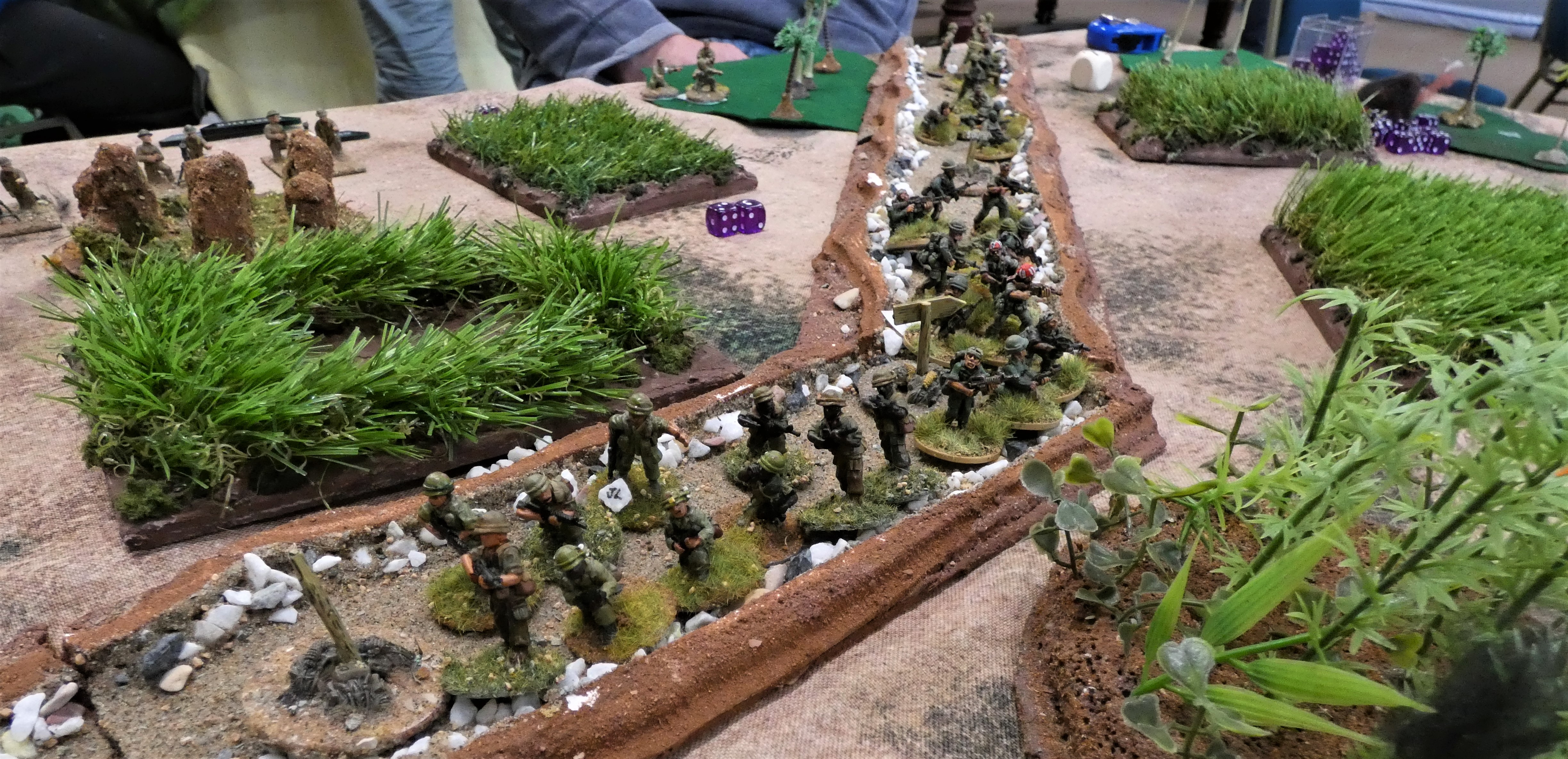
ANZAC's in Vietnam - Chain of Command

Members of 5 Platoon, B Company, 7th Battalion, The Royal Australian Regiment (7RAR), just north of the village of Phuoc Hai, beside the road leading to Dat Do.
https://en.wikipedia.org/wiki/File:7_RAR_Vietnam_(AWM_EKN-67-0130-VN).jpg

Today I organised a Chain of Command game, set in Vietnam 1964. The protagonists were the ANZAC forces against the North Vietnam Army (NVA). I wrote up a fictitious scenario briefing for both sides, which you can read below. 

The core CoC rules were modified for the period using Jason Sendjirdjian’s supplement DMZ Second Tour. You can find a copy of this supplement here:

http://carportgaming.blogspot.com.au

The engagement is scenario six in the core rules book – attack on an objective, which is a small NVA supply dump. 

The victory conditions are either per the core rules book, of a political victory per the DMZ supplement.

The ANZAC political victory is to secure two jump of points with their force morale of +4. The NVA political victory is to withdraw their forces from the table with a force morale of above 0 and reduce the ANZAC’s morale to +3 or less. 

Both sides are regulars with 5 command dice.

Most of the terrain is covered with a rubber tree plantation, in the photos this is the green area that cover most of the table, there are some trees on it but otherwise please use your imagination. 

The plantation gives a variable line of site of 12”+1D6. There is a stream bisecting the table but the banks are deep; troops inside the stream are out of LOS, unless the observer is directly on the lip of the stream. The stream counts as a major obstacle to cross to.


Briefings
ANZAC BRIEFING: Patrolling is the cornerstone of our operations in Phuoc Tuy Province. Rather than wait behind the wire for enemy attacks, our patrolling denies the enemy the element of surprise.

However, things may be about to change as SIGINT reports the transfer of the 129th NVA Regt to Phuoc Tuy Province; the 129th are known to be a hard-core NVA regiment. 

Federal Elections are due in Australia and HQ suspect that an all-out attack may take place shortly, to undermine domestic support for Australia’s involvement in Vietnam. Brigade HQ has ordered a significant increase in the number and size of patrols in our AoO, to detect and disrupt the enemy.


Despite air reconnaissance efforts, no significant sign of the 129th has been detected. This is probably because the 129th is dispersed below the canopy of the various rubber plantations here abouts. 

This Province is known for many good fresh water sources and it is reasonable to assume that units of the 129th will not be far away from these.


NVA BRIEFING – 129th REGIMENT: 
Our regiment has seen continuous high intensity action against US capitalist forces and their local lackies, for the past six months. Despite much successes, High Command recognised that our regiment needs a period of rest, reinforcement, and resupply, before returning to the liberation struggle. 


Our regiment has been sent to Phuoc Tuy Provence, a quiet coastal area where supplies and men can be smuggled in by sea, rather than using the arduous jungle route. You are reminded comrade, that “rest” does not mean idleness; both new and established comrade-soldiers are to be subjected to both physical and ideological training. 

The regiment will be distributed amongst the many rubber plantations that dominate the country here abouts. Local volunteers report that the area has abundant clean water sources and food will be provided by the local population. 

Construct a simple camp and training area for your platoon, near a suitable water source and await further orders.


How the game played:
As with all the games I put on at the club, they never play out as I expect; I suppose that is part of the fun of being the GM. This is especially so when there are experienced CoC players involved and today was no exception, with two of our club CoC stalwarts involved against each other. I think it was Napoleon Bonaparte who said “Don’t give me a good general, give me a lucky one” and today’s game had a good deal of unusual luck. 

For those familiar with the CoC rules, will know that rolling double-six on the command dice entitles the phasing play to a repeated phase, rather than passing the next phase initiative to the opposition. I don’t think I have ever seen a CoC game with so many double-sixes rolled.


The ANZAC’s started with a good force morale dice roll, putting their morale at 11. The NVA weren’t
so lucky with their dice roll, but they did get a force morale increase of 1 for being highly indoctrinated, putting their morale at 9. 

The ANZACs used their support points for a fourth infantry section and an ambush. The NVA opted for an entrenchment, which they never used and for local knowledge, which allowed them to move a JOP 18” without the need for an accumulating Chain of Command dice.


As attackers the ANZAC’s were the first phasing players and away the game went with a big start. The ANZAC’s rolled double-six with their five command dice, which allowed them a second go. With the almost certainty of being able to bring on a large force over two consecutive phases, the ANZAC’s went big on deployment. As well, the ANZAC sections had dedicated scouts, which were pushed forward towards the nearest NVA jump of point (JOP). 


Now it was the turn of the NVA, who replied in kind, as they rolled double-six too. Wishing to seize an early advantage, the NVA, knowing they were going to get the next phase, used their local knowledge to advance one of their JOP’s to outflank the ANZAC’s. 

Two NVA sections were deployed in a reverse L deployment. One section on overwatch and the other engaging the ANZAC’s directly.


Now the ANZAC’s replied expecting a back and forth engagement, but on the next NVA roll of the command dice it was double-six again and the double phases were causing the ANZAC’s casualties to pile up. 

Realising the need for a determined response to wrest back control of the situation, the ANZAC’s used their ambush support option to deploy the fourth section to face off against the NVA and bring on more firepower.


Next the NVA rolled double-six on their command dice again and the volume of fire directed at one of the ANZAC sections became too much and it routed away. With an extra section and a good force morale, while unexpected, this wasn’t a major setback for the ANZAC’s. 

Now it was the turn of the ANZAC’s to roll double-six on their command dice as they moved another section into a better firing position and laid down a heavy fire on the NVA, causing some casualties, but a lot more shock on the NVA. 


And how did the NVA reply? With yet another double-six command dice which enabled them to reduce their shock in the first phase. Unlike the man rules set, in the DMZ supplement, units can go up and down on the combat shock effectiveness ladder, provided there are sufficient command initiatives to do so.

With the second roll of the command dice the NVA returned fire.


By now the ANZAC forces were starting to outflank the NVA position, allowing more and more figures to get into a good firing position. Again the ANZAC’s laid down a withering fire causing casualties and a lot of shock on the NVA; it looked like it was getting to be the end for at least one of the NVA sections. 

You guessed it, the NVA rolled their command dice and up came double-six. With an elated smile the NVA repeated what they had done the previous phase, using the first phase to remove shock and rolling again for unit activations to fire back – but – the dice gods were generous but not in the way expected.

All the NVA dice end up showing a 5!


For those of you who have played CoC, you will know that a roll of five on one of the command dice increase the accumulating Chain of Command dice by one step; once it gets to six the owning player has other options. 

In one sweep the accumulating dice came good for the NVA, with some more points carried over. But without being able to fire back at the ANZAC’s this was a very mixed blessing. 


Sure enough, the ANZAC’s didn’t miss their chance; with another round of casualties and shock inflicted on their enemy, the NVA’s position looked increasingly precarious.

The next phase was decision time for the NVA, now they had six on the accumulating dice they had the option to move their JOP again. Perhaps move it to where the troops were and then disappear down the hole? 

Unfortunately, the rule requires the JOP to be out of site of the enemy before this is allowed and the gradually outflanking ANZACS were too close now. The NVA took off some shock and hoped for the
best.


The next ANZAC phase pretty much settled things as the ANZAC firepower superiority started to dominate. 

One of the NVA units routed and the other was in a helpless way; the NVA overall company force morale was down to four as well. At this point the game was as good as over for the NVA, since the ANZACs now out-numbered them three to one and would easily capture two JOP’s per the political victory.


All agreed it had been a ferocious game, dominated by some very unusual command dice throwing!

Thanks to Bob the ANZAC and Nathan and Ian as the NVA who’s good plan was thwarted by the dice gods. 

Figures by The Assault Group, Empress Miniatures, Gringo 40, Command Miniatures amongst others.

Stephen Huntsman.

Tuesday, 28 March 2023

Mini la Drang - Chain of Command

 
This was a warm up game for a larger game planned for the summer where we plan to re-fight la Drang in the Vietnam War. This was the second warm up game, in the first the NVA won hands down so tweaks had been made to rules. 

https://carportgaming.blogspot.com/2019/09/on-road-again.html

This game was played using Chain of Command with amendments from DMZ v2, then with house rules. The terrain was based on a board game called “It Started Here”. The US had two infantry Platoons the NVA also had two plus some extra sections and heavy weapons.


The game started with a patrol phase in the basic rules. This went well for the US as they managed to control the dry river bed. The NVA had however had the jungle covered hills.


When the game proper started the US capitalised on having the dry river bed and brought on their the majority of their sections. This formed a impressive fire base. The NVA were slower deploying and basically became out gunned. To add to the pain “off table support” in the form of artillery and air attacks just compounded the the problem.


The NVA battle plan was to be aggressive which only made things worse.

As a historical re-enactment of a Vietnam battle, the results were realistic, US firepower is all powerful. However as a game not a good day out for the NVA.


Changes made to the rules were mainly to reduce the casualty rate. This was done by reducing ranges and the addition of a Spotting Dice (lifted from O Group rules). The Spotting Dice if failed made the terrain effect a level better.


Figures used for this game were 28mm mostly Parkerfield Miniatures, West Wind and Rubicon.


Scenery scratch built (except trees), this included the first Ant Hills I have ever made.


Thanks to Andy, Vince, Nathan and Steve M for giving the house rules a good testing.

Saturday, 3 September 2022

MOURIR POUR L’INDOCHINE 1951, BIG CHAIN OF COMMAND - The Battle of Song Dai (The River Day), June 1951

By 1947 France had largely regained its Indo-China colony (today Vietnam, Cambodia, Laos), except for Ho Chi Minh’s hold-out in the mountainous jungles of northern Tonkin.  

On 7th October 1948 French paratroopers descended and a pincer force encircled the Viet Minh (hereafter VM); but in this terrain pincers and encirclements were meaningless. The VM slipped away, mostly into China. The French built a string of border-forts but Hanoi was 300 kms away and the mountainous roads poor.  

In China, Ho’s military lieutenant General Giap, built up the VM army from one of battalions to one of divisions. In October 1950 the French boarder-forts were over-run and the retreating French forces decimated; low morale and civilian panic stalked Hanoi. The Chinese had entered the Korean war so the USA was unlikely to rescue French Indo-China.  

1951 was the year for the VM knock-out blow

The de Lattre Line under construction and the line around the delta area. Vinh Yen, Mao Khe, Nin Bihn and Phat Diem are shown on map.

Paris now sent General de Lattre de Tassigny, a soldier in the highest French tradition, to Hanoi with combined military and civil powers.

 In 1940 his division fought creditably and never lost its cohesion. Under Vichy command, he had been imprisoned for defying their orders, but escaped to join the Free French. As a senior allied commander in the liberation of Southern France and the advance into Germany, he had commanded both French and US units. De Lattre signed the formal surrender of German forces, alongside Eisenhower, Zhukov and Montgomery. And now de Lattre was in Hanoi, with an icy determination to restore France’s fortunes. 

De Lattre ordered blockhouses and strong-points constructed to surround The Red River Delta, “The de Lattre line”, to protect the economic heartland of Tonkin. French male civilians were drafted for guard duties to release troops from garrison duties, the evacuation of the women and children was cancelled. But de Lattre could not stop the VM posters saying that Ho Chi Minh would be in Hanoi for the coming Tet festival (February 1951). 

General de Lattre de Tassigny and his son Bernard.
Bernard was killed near Ninh Binh on 30
th May 1951.

The VM did not disappoint. In January 1951, Giap attacked the north-western end of the de Lattre line, at Vinh Yen, aiming for Hanoi. French defences were overrun by VM human-wave assaults; mobile reinforcements were ambushed and destroyed. De Lattre flew into Vinh Yen to take personal command. More troops were flown in from the south and every aircraft capable of dropping ordinance was drafted in; the French managed to hold the line. Not deterred, in March Giap shifted his attack to the north-eastern end of the line near Mao Khe. Here an advance of 20km’s would threaten Hiaphong. Fortunately for the French, the river is deep here and naval forces moved upstream to break up VM attacks with concentrated firepower.

Graham Greene described Phat Diem cathedral as
“more Buddhist than Christian” in his novel ”The Quiet American”.

Giap now attacked for a third time. This time the VM switched to the southside of the delta, where it is bounded by the River Dai (Day). Giap planned to cross the river around the town of Ninh Binh and then swing south east to unhinge the French position from the south. French outposts here were not strong because the Catholic Bishop of Phat Diem was equally nationalistic and anti-communist; the bishop was determined to stay out of the war. 

Giap concentrated his forces secretly and attacked the French on 29th May. Caught by surprise, initially only limited local reinforcements were available, but now more experienced, the French acted faster. Gunboats were sent upstream to sink the sampans and junks that were the VM’s life-line. Armoured mobile forces and paratroopers were sent south to counter the VM attack. French artillery and airstrikes were very effective as the VM manoeuvred in the open rice paddy terrain. Fighting was intense with outposts changing hands several times, but by the middle of June the VM’s position was untenable and Giap withdrew; it is these attacks that form the backdrop to our game today. 

While the Red River Delta area had been held, the French would never successfully sustain a presence in Tonkin outside of the delta area again. The VM would consolidate their hold on Tonkin and expand their operations elsewhere in Vietnam and Laos with increasing confidence. General Giap would not attempt to take on the French directly again until 1953 at Dien Bin Phu, which is far away from The Red River delta. General de Lattre returned to France due to ill health and died the following year.

Order of Battle and rule modifications

French Union Forces

One platoon of 10th Moroccan Paratroopers (two sections) – Elite (1 extra command dice 1 to 4 only)

One platoon of Vietnamese infantry (three sections) – Regular

Mobile force with limited organic infantry support – Regular

Off table support fire

Viet Minh

Two platoons of main force Viet Minh infantry (three sections) – Regular,

One platoon of local and infiltrated Viet Minh troops (three sections) - Green

Demolition team, 2 x bazooka teams.

Off table support fire.

Viet Minh troops are highly indoctrinated: regulars add one to the force morale roll, green do not, minus two.

Chain of Command rules: per the main rule book set and the DMZ second tour supplement.

Off table Support Fire.

Both sides have off table support, at both the company and regimental level. Company level support weapons are deployed onto friendly jump off points, counting the JOP as the point for line of site and range. If the JOP is over run the support weapon is removed from play. These weapons include recoilless rifles, mortars, MG’s etc.  In addition, off-table artillery strikes can be called in by the normal rule procedure, with VM strikes counting as 50mm mortars and the French as 81mm mortars. The French also have the option for airstrikes.   

Terrain: the paddy fields count as heavy going for all movement. Only fully tracked vehicles can move in the paddy fields. Vehicles hit crossing dykes count as weakest lowest armour grade.

There were sufficient players today familiar with the rules, Chain of Command by The Two Fat Lardies and the Vietnam DMZ supplement by Jason Sendjirdjian of Car Port Games for them to play without much interference from me.

https://carportgaming.blogspot.com

Jason’s supplements cover both the war in South Vietnam and the earlier French Indo-China war; there is other material of interest on Jason’s blog too.

The VM had two regular platoons of infantry and one green platoon of local troops; all VM troops are highly indoctrinated and have improved morale. The French has two infantry platoons, one of elite Moroccan paratroopers and one of local recruited regular Vietnamese and their Force Mobile column of vehicles, with its organic limited supporting infantry.  

Both sides are attacking each other, as this is a no holds barred attempt to destroy your enemy and seize terrain – the prize is Indo China. The VM have a significant advantage in manpower but the French are supported by vehicles from their mobile column, while the VM have no vehicles.  

The paddy field terrain is heavy going and impassable to wheeled vehicles and the field bunds make good defensive positions. The VM didn’t forget to bring along their anti-vehicle weapons too and they are in position of the now abandoned French strong point.  

Both sides have off table weapons at the company and regimental artillery level. The French have access to airstrikes too. 

With the patrol phase completed the main action began. The VM won the initiative but both sides seemed oddly cautious to start, just rolling command dice to build up chain of command points; perhaps it was the early morning mist or the mid-day heat.  

The absence of people working in the paddy fields was a sure sign something was going to happen soon however.  Cautiously the VM pushed out some local troops probing towards the French lines. Spotted by the French this unit was engaged by off table recoilless rocket fire, using high explosive rounds. 

Soon more and more units of VM appeared crossing the paddy fields towards the French jump off points, to be met by counter deployments of French troops. The VM players clearly understood that their best option was to close in on the French and initiate close quarter combat.  

A French JOP was threatened and the owning player had to use a Chain of Command point to redeploy it somewhere safer. 

The French players brought their artillery observation teams on and soon called-in off table fire.  The artillery strikes supporting the locally recruited Vietnamese troops proved to be particularly effective.  But notwithstanding the VM pressed home their close quarter attack on a Vietnamese section; even though the VM squad was wiped out, they had caused sufficient casualties and shock for the Vietnamese unit to rout too.  

Here the higher motivation of the VM was a clear advantage as they were better able to absorb these types of setbacks; soon the Vietnamese were suffering from declining morale.

By now the French Force Mobile had arrived deploying along the road and railway line – hoping to dominate the centre part of the battlefield with their machine guns. Unfortunately, a VM recoilless rifle team had got the range and a half track and armoured scout car were soon knocked out.  

An M8 Scott motorised howitzer was deployed, but the junior leader was soon wounded by mortar fire, in the open topped turret; the M8 got off the road into the paddy field out of line site of that VM recoilless rifle and continued to engage the enemy, but with less efficiency.  

The French continued to rely of their company level off table support fire in the centre – but it wasn’t really adequate as the VM pushed forward. 

With the VM pressing forward everywhere, could the Moroccan paratroopers save the day? A smaller than usual unit for chain of command, the elite paratroopers have enormous fire power. The off-table artillery fire kept the VM at reasonable bay on the one flank while the Moroccans held the other, but still the VM pressed forward helped by a reasonable number of double phases – fortune favours the bold.  

So important was the continued artillery fire that the Vietnamese player used another Chain of Command point to keep the fire going at the point in the game where it would normally cease. And the Force Mobile used their chain of command point to ambush advancing VM troops, wiping out a depleted VM section before it could close to close quarters.  

Eventually the Vietnamese troops had had enough and their morale collapsed to a point where they could no longer participate in the action. Fortunately for the French the VM had received sufficient losses so that they were unable to exploit this success.  

On the other flank the VM, despite the Moroccans’ fire power, were still able to close to close-quarters combat.  There was a large disparity in the fight, but the VM still managed to force a draw, causing another immediate round of hand-to-hand combat, where the disparity was even greater, but despite the VM being destroyed casualties were inflicted on the Moroccans.

By now the French were getting the upper hand, but only centimetre by centimetre. Their firepower had succeeded in holding off the VM sufficiently that insufficient numbers could break through to “grab their belts to fight them”.  

The delta would be held today, but what would tomorrow bring?  Certainly no respite for the Moroccan paratroopers or the Force Mobile, who would be called in to plug another gap and be slowly worn down by the constant operations. 

Thanks to Bob and Greg for being French, and Nathan and Steve M for being the VM.  Miniatures mostly from Empress and Gringo 40, vehicles mostly Rubicon.  

Historical background source mostly “Street Without Joy”, by Bernard Fall.

Stephen Huntsman