Labels

Saturday, 2 April 2022

Maurice - Seven Years War Austro-Bavarians vs Prussians

Heroics to the front as the infantry get close and personal in our Seven Years War clash using Maurice

Last month, Maurice featured at the Devon Wargames Group, as Martin entertained us with a Seven Years War Prussians vs Austro-Bavarian clash, using his Pendraken 10mm collection that got its first run out on JJ's Wargames, see link below, as Steve M and myself reacquainted ourselves with a favourite set of rules.

http://jjwargames.blogspot.com/2022/03/maurice-in-seven-years-war.html

Our club game was a much larger affair that saw the Austro-Baviarian force lined up on a long ridge overlooking an important river crossing before a small village with two bridges, one leading through it and the other further upstream.

The Bavarian division man the hill directly behind the village on the river. These four battalions would be in the thick of the fighting before the games end.

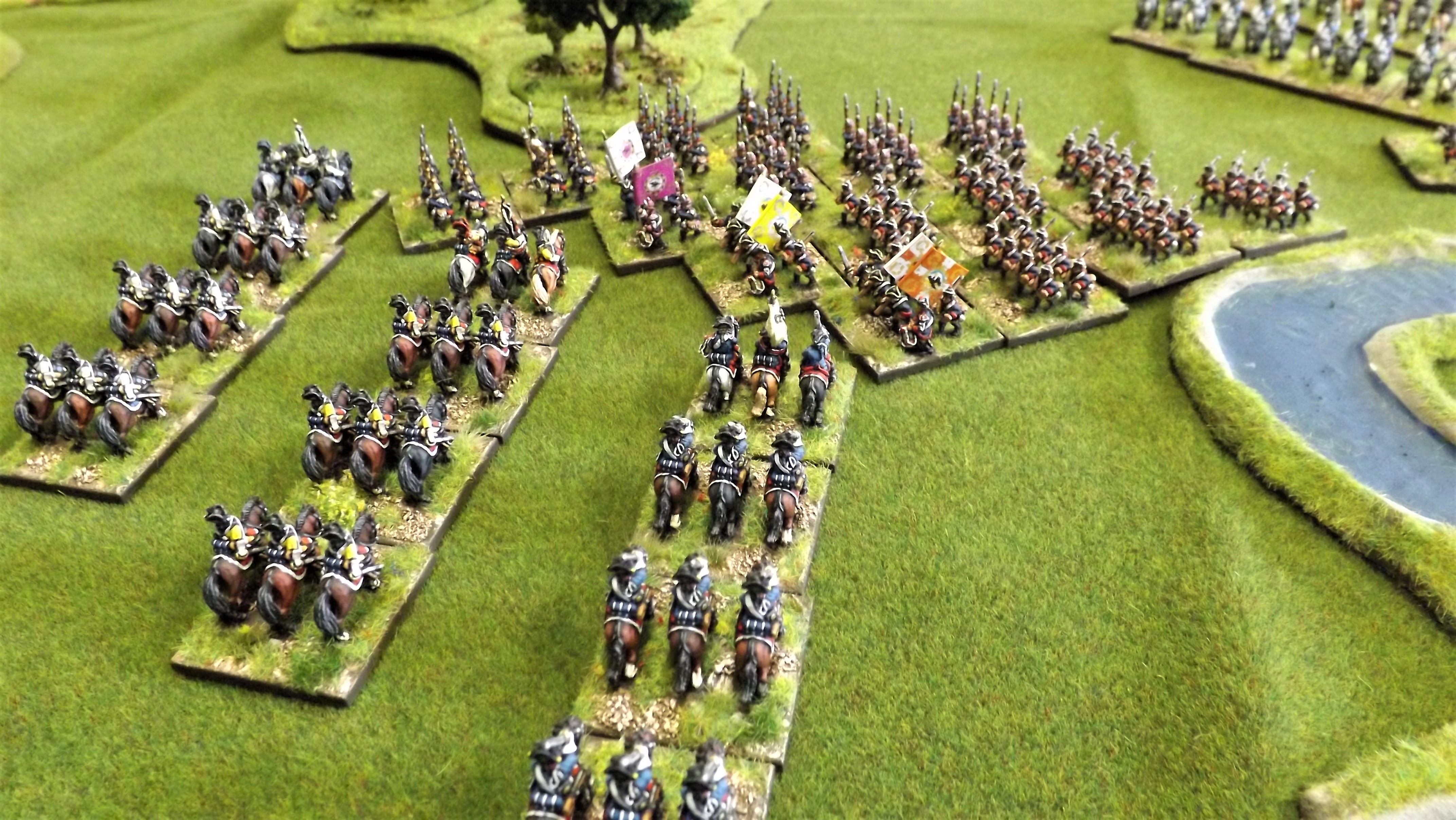
The Austrian general in command was busying himself overseeing the extraction of a rather important convoy of foods and munitions that were hastily assembling in the village, together with some important nobles and their ladies, keen to avoid an early introduction to the Prussian General Staff; and to cover their withdrawal a brigade of Austrian cavalry supported by Croatian Grenz covered the approaches.

The rear-guard force cover the withdrawal of the supply column

Important nobles and their ladies gather their belongings ready to join the retreat

Croatian Grenzer

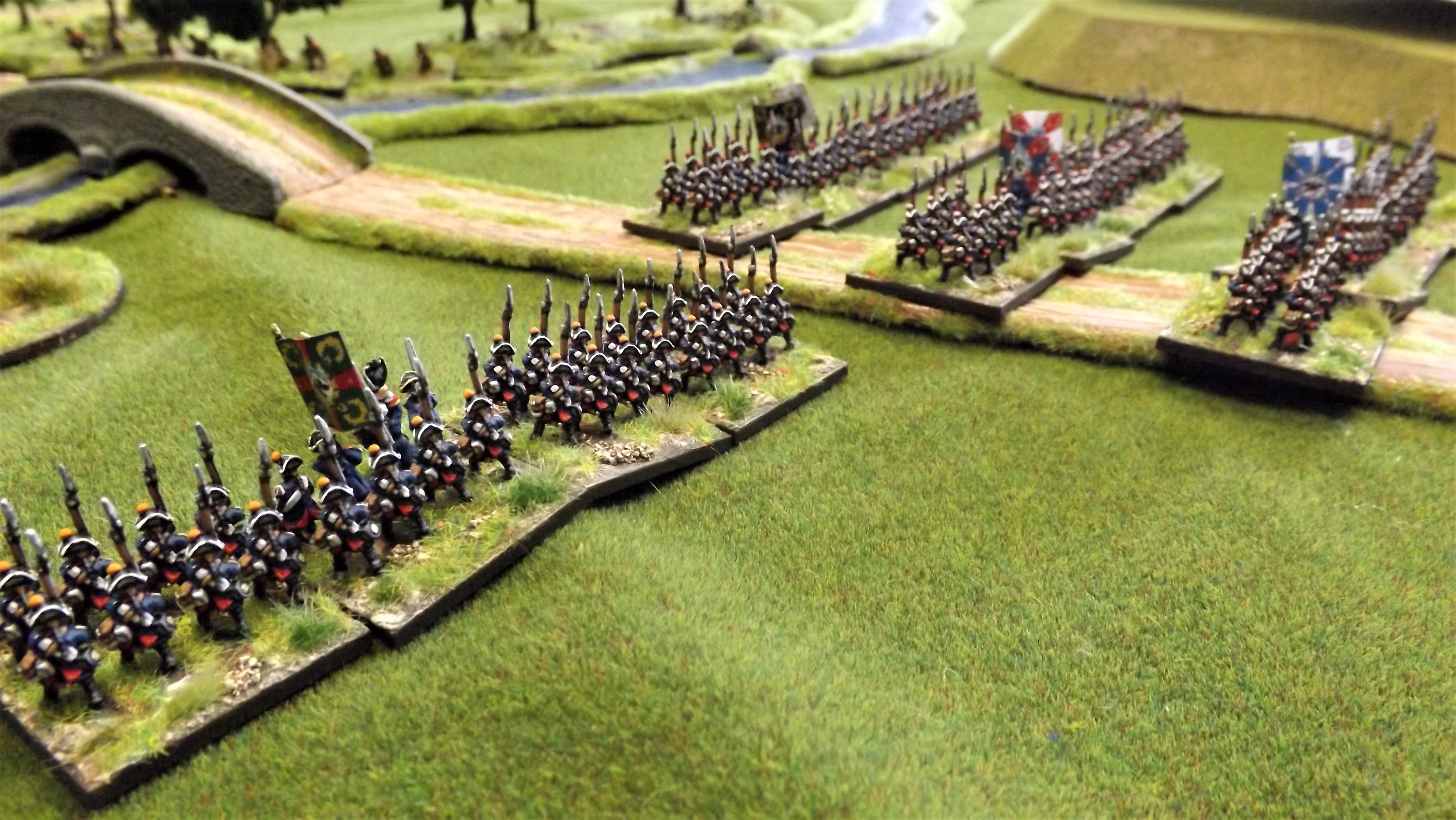
Croatian Grenz cover the bridge, and road into the village 

Steve M and Gregory were tasked with administering the Austrian rear-guard, as Vince and I prepared to lead the charge on the behalf of the King of Prussia as our advance guard came up the road ready to challenge the Austrian possession of said village with jaegers and cavalry to the fore, closely followed by the main army ready to exploit an early success by crossing the river to challenge the main Austro-Bavarian army lined up on the ridge beyond.

Jagers and Prussian Hussars lead the advance guard of the Prussian army

Martin had managed to squeeze an exquisite level of detail out of these very small miniatures that only added to the enjoyment of our game. 

The early card play in Maurice is very often a case of one army getting into a position where it is ready to contest with its opposition.

The Prussians in this case, were forced to spend their cards trying to orchestrate the movement of their forces whilst the opposition did its best to frustrate and disrupt those movements, looking to create an opportunity for a counterattack or to weaken a later enemy advance.

Further along from the Bavarian division on the ridge beyond the river lay the main Austrian army supported with some very well laid artillery covering the approaches to the bridges.

With the village an obvious route of advance on perhaps the weaker part of the Austro-Bavarian army, we decided to clear the village with one part of the Prussian army while the other part got across the river upstream and shook out into battle order ready for an advance.

Austrian cavalry in force completed the army over watching the withdrawal


The battle for the village and its bridge became a fierce skirmish between the Grenz and Jaegers with the later able to shoot their way into the village and clear it with the sword bayonet and both the opposing cavalry stared at each other as the battle progressed.

With an early indication of the accuracy of the Austrian gunners, the main Prussian infantry force of elites and grenadiers together with the bulk of the cavalry quickly crossed upstream of the village and sought shelter in the lee of nearby woods as the jaeger cleared the village of Grenz opponents

The Prussians were also quick to support the river crossing with their own force of heavy guns

With the village cleared, the second division of Prussian infantry crossed over the river and deployed close to its outskirts, whilst the other infantry force and main Prussian cavalry were sorting out their messed up crossing behind the woods close by,  caused by rather accurate Austrian gun fire during their passage.

The second division of Prussian infantry followed the jaeger and light cavalry to support their advance and to threaten the Bavarian flank

As Gregory pulled the Bavarian cavalry back from the village, Vince spotted an opportunity to exploit the move by ordering up the Prussian infantry to advance in pursuit in line, a formation that, provided the flanks are secure, is a very dangerous threat to any opposition, given the deadly firepower of Prussian infantry of this era.


The move by the Prussian infantry proved to be the principle attack of the Prussian army leaving the other flank quiescent as the attack demanded the limited pool of activation cards to support it and seeing the Bavarian cavalry with its back pinned against its infantry that had come down from the hill behind in its support, as the Prussian muskets went to work.

The Grenz are forced back into the village by accurate Prussian rifle fire and would be destroyed later by the follow up close assault

The Bavarian infantry looking secure in their lofty perch above the village soon to find themselves in front of massed Prussian musketry

The front Bavarian cavalry regiment was decimated before the Prussian fire, and as the Bavarian infantry came forward to cover the retreat of the remaining horse, they to found themselves battered by a similar musketry fusillade followed by a charge.

In desperate need to turn the tide in their favour the Bavarians traded activation cards to bring up their single artillery piece to help, but it was too little too late as the Prussians traded battalions for battalions, whilst relying on Gregory to continue to throw sixes every time a units was destroyed, further adding to the loss in army morale points that inevitably followed.
 
With the Grenz hard pressed and eventually broken around the village, the Bavarian general ordered the cavalry rear-guard to withdraw on his main force

The Prussian second infantry division consolidate the hold on the village with the Grenz destroyed and the Bavarian cavalry withdrawing. Then Vince ordered the advance!

Behind the woods space was a premium as the main elite Prussian units sorted themselves out beyond the reach of Austrian guns

The really clever piece in card play with Maurice is that combat inevitably consumes cards rapidly in activations and event moderations, and the need to pause the fight as both sides attempt to rally off their disruptions.

In those pauses the other quieter parts of the front may get the opportunity to influence the battle within a battle by causing the enemy to react to other units elsewhere doing other threatening moves which forces card play in response.

Having crossed the river the Prussian guns deployed in preparation to cover the next phase of the advance, with a weather eye on that advancing Austrian cavalry, top left

The sudden withdrawal of the Bavarian cavalry offered an opportunity to exploit and the Prussian general in charge martialled the infantry to prepare to advance in hot pursuit.  

Thus the Austrian main cavalry advanced out into the plain, seemingly looking to threaten the main Prussian line and cause a reaction to take the pressure off the Bavarians.

Sadly the Prussian line responded with its first infantry division and artillery mutually covering all approach routes that the Austrian cavalry might close through and thus stymying this advance allowing card play to return to the battle before the Bavarian hill.

The Prussian advance on the Bavarian hill

The table overview at the close of our game shows the advance of the second Prussian Infantry division on the main Bavarian position as it moved off in pursuit of the Bavarian cavalry that withdrew from the village. To try and threaten this advance the Austrians advanced their cavalry but halted before getting in sight of the Prussian gun line. Note the Prussian infantry in line behind the woods to prevent any cavalry advances in that direction

The same overview from the Austrian positions

As our game came to its inevitable close and with the pub beckoning, the Prussian second infantry division and the Bavarian division lay battered at the foot of the hill behind the village, with both sides desperate to replenish their hands of cards, looking to rally off disruptions, bring up much needed supports and keep on killing the enemy, but unable to do all of it at the same time!

This is another glorious modelling of this type of linear warfare, artfully captured in the play, and it was the card play that had the last laugh as with the opportunity to cause the Austro-Bavarian army to teeter yet closer to calling a withdrawal, the Prussians played the 'Death of a Hero' event card which seemed very appropriate amid the carnage in front of the Bavarian position and more morale dropped from the Austro-Bavarian army card in the last phase of play.

The early decision point as the Prussian infantry lie battered before the Bavarian line having lost two battalions and the third one on the extreme left of picture teetering on three disruptions (red die) but with its Bavarian opposition in a similar state. The other two Prussian units accounted for two Bavarian infantry units and a cavalry regiment destroyed by their musketry, added to the two Grenz units destroyed in the fight for the village. Not the other Bavarian cavalry unit teetering on four disruptions, and both generals in close attendance.

The opposite flanks of the two armies were comparatively quiescent as the fighting on the Bavarian flank consumed the bulk of card play and activations

At the close the Prussian army morale was still riding high on the success of the assault by the Prussian infantry down five army morale points on a start of eighteen

What a game and its leaves me a little exhausted writing it up a few days later, but adding to the catalogue of memorable games played with this clever set of rules.

The Austro-Bavarian force in comparison was in a desperate state with a loss of twelve points, added to in the last turn with the Prussian play of the 'Death of a Hero' card that saw another two point decline as an important Bavarian officer was seen to fall at the close.

Thank you to Martin for bringing along his glorious collection of figures and terrain to provide all the fun and to Vince, Gregory and Steve M for making an enthralling and entertaining encounter in the Seven Years War with Maurice. 

Good times

JJ

Saturday, 26 March 2022

Vietnam 1962 – Chain of Command


I have always enjoyed playing Chain of Command (CoC) by the Two Fat Lardies. Originally written for
late World War Two, I have enjoyed playing CoC games ranging from the First World War to Vietnam. Today I organised a CoC game set in Vietnam using the rules supplement “Chain of Command DMZ- Second Tour”, by Jason Sendjirdjian of 


Jason’s supplements cover both the war in South Vietnam and the earlier French Indo-China war; there is other material of interest on Jason’s blog too.


Our game was set in South Vietnam in 1962, the time of Premier Diem, when there were about 15,000 US military “advisors” in South Vietnam’ the crashed light aircraft represents one such US intervention “Operation Farm-Gate”. 

The USA had long been involved with Vietnam in some way or other. In WW2 the US supporting the Vietnamese nationalists/communists against the Japanese and then the French against the same nationalist/communists. The protagonists in our game however, were strictly The Army of the Republic of Vietnam (ARVN) and the communist Viet Cong (VC). 

At this stage of the Vietnam conflict, engagements were mostly of a small scale, unlike those following the deployment of thousands of US troops to South Vietnam.

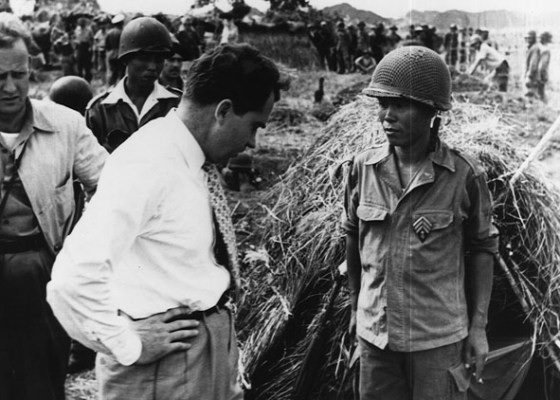
Senator John F Kennedy (in the rear right) visiting French Indo China in 1951. Kennedy was critical of US support for the French saying “We have allied ourselves to the desperate effort of a French regime to hang onto the remnants of empire”, but once he became The US President he supported The South Vietnamese Government, in their struggle against the same foe. After President Kennedy was assassinated (1963), his successor President LB Johnson committed US troops directly to the support of South Vietnam. By 1967 there were around 525,000 US military personnel in South Vietnam.

1953, US Vice President Richard Nixon visits French Union forces south of the Red River Delta, near Hanoi. The VP said he was impressed with the high morale of the French Union troops and this was a rugged and rough war. President Nixon ended Americas involvement in Vietnam in 1973.

The Game
All four players in our game were familiar with the main CoC rules, which made being the GM much easier, once the Vietnam specific rules had been explained. 

The army lists for both armies are available on Jason’s site, for those interested. 

The ARVN is based along reasonably conventional military lines, equipped with US military equipment. The VC are equipped with Soviet/ Chinese weapons mostly the SKS automatic rifle, rocket propelled grenades and light machine guns. The ARVN use the conventional morale system in the main rules set, but the VC, being irregular troops (farmers by day, soldiers by night) use the CoC irregular forces morale rules. 

The ARVN morale is pretty flaky as they have to take a morale text for every figure killed; this represents the problem of building-up a national army while a conflict was already underway. 


As a side note, President Diem of Vietnam, while deeply anti-communist was also deeply anti-French. Once Vietnam was divided into north and south, Diem insisted the French depart South Vietnam without delay, which did not allow much time to build up a new national army to replace the departing French forces. The result was an urban franco-phone, Christian officer corps commanding Buddhist, Vietnamese speaking soldiers recruited in rural area. 

Corruption was a persistent problem too, the US Embassy called The President “Per-Diem”, the Latin for “daily rate of pay”. The communists had, on the other hand, a simple and consistent message based around national reunification and social/economic equity of the Marxist/Leninist brand, though much of the latter went over the heads of the rural folk.


Our game was set amongst the paddy fields in the Mekong Delta region, a tranquil and bountiful region of the world. The players rolled to select the scenario and it was scenario four, a delaying action by the VC (page 77 of the main rules book). 

The ARVN morale was pretty good and the patrol phase quickly completed. The ARVN players had selected an extra section from their support points, along with a sniper and one round of off-table support fire. 

The VC selected…well that was for the VC to know and the ARVN to worry about. The ARVN advanced quite rapidly through the paddy fields enjoying good movement dice rolls and a double phase too (2 x D6 command dice), despite the terrain being heavy going. 

The ARVN wisely kept off the paths between the fields and made good use of the field bunds to give them hard cover wherever possible. The ARVN sniper took up position under a farmer’s hooch to keep watch but the VC were not to be seen.


After several phases of command dice rolling, all hell broke loose as two large groups of VC appeared from their hide-out Jump off points. As irregulars the VC didn’t have a formal unit structure, their force consisted of 27 figures armed with SKS rifles and two NCO’s, to be basically organised as the VC players wished. 

The VC support options allowed some rifle armed figures to be swopped for RPG and light machine guns and the VC had taken these support options. 

The VC are considered poor shots, so they deduct one from the to hit dice roll, but the volume of fire directed at the ARVN meant shots were finding their mark and ARVN troops going down. The effect on the ARVN’s flaky morale was soon felt, despite their returning fire and inflicting losses on the VC. 

The VC, using the irregular rules for morale absorbed these casualties, especially when the VC’s motivation increased as they saw the ARVN casualties pile up. Not withstanding their casualties, the ARVN players took full advantage of the extra infantry section they had used their support points for, to push forward. 

Once the VC had exhausted their three RPG rounds carried, they disappeared from view, back down their JOP’s.


The ARVN’s victory condition was to capture two VC JOP’s and now the field was clear for them to do so. The ARVN used a chain of command dice that they had now accumulated to relocate their sniper forward to a position within four inches of a VC JOP, shutting the JOP down so the VC could no longer deploy from it. 

Elsewhere the ARVN advanced as fast as possible, taking advantage of the VC’s temporary absence, to seize a second JOP. Alas the earlier good movement dice rolling for movement seemed to have deserted the ARVN, just when it was needed. 

Sections were stuck out in the middle of paddy fields, without adequate cover and the VC were ready to pounce. Having good local-knowledge the VC were allowed to relocate one JOP up to 18 inches, once in the game. The VC proceeded to move the JOP shut-down by the ARVN sniper, to an advantageous position on and behind the ARVN’s flank. Now deploying from this relocated JOP the VC poured fire into two ARVN sections that had previously enjoyed the hard cover of a rice paddy bund.


At the second JOP the ARVN were targeting; the VC deployed their master-stroke by ambushing the ARVN with a medium machine gun concealed in a bunker. This was a bit of a gamble by the VC as this
support option had used up most of their support points, but it paid off for them. Despite valiant attempts by the ARVN to fight back, the loss of command-dice due to declining morale, meant the engagement was over for the ARVN.


As everybody had enjoyed the game and it was decided to play another game on the same terrain to take advantage of lessons learned. This time Scenario 3 was selected form the main rules set – attack and defend, with the ARVN as the attacker. 

The ARVN pushed their patrol markers deep into VC territory concentrating on dominating one flank only. This time the ARVN had selected extra off-table support fire, rather than an extra section as their support options. Again the ARVN pushed forward quickly to seize the nearest VC JOP. 

This time there was no delay from the VC who deployed two groups of fighters, jointly commanded by their inferior senior leader. The nearest ARVN section was subjected to murderous VC fire, but put up a good fight with support fire from the other two sections. 

The ARVN senior leader called in the off-table support fire, but as soon as the VC realised what was to happen they surged forward to melee the hard pressed ARVN section, which by now was denuded in manpower and pinned down. 

So great was the VC’s advantage in the melee (more than four times as many combat dice) that the ARVN troops simply broke, before the melee took place. With so many morale rolls on the “Bad things happen” table, the ARVN morale collapsed again. Try as they might the ARVN couldn’t get the artillery right and the game was declared another VC win. I think it must have been the shortest CoC game I have ever seen.


Thanks to Jeremy and Colin for playing the ARVN and Bob and Nathan the VC. We all agreed that while we were playing CoC, the feel of the game was different and reflected the historical difficulties of the time and situation quite well. I look forward to more CoC games set in Vietnam and French Indo-China, where things are even more desperate! 

Saturday, 12 March 2022

Baron's War - "Conquest!"

Background
The year is 1068, King William did not have full control of his new kingdom. Harold's sons are organising raids on the South West together with their Viking Allies. Local collaborator Saxons are organising the militia defence and fast moving Norman Lords are there to come to the aid of the militia.
This months game was a four player game set up to reflect this situation.


Saxon Militia had set themselves up in a village in the centre of the table, just before the attacking Saxon Exiles and Vikings arrived. On the opposite table edge the Normans were poised ready to support their loyal subjects.


This was to be our club's first game playing Barons War, none of us had played the rules before so each force was given different characteristics. 

Saxon Militia – third rate force. Thegn, Fyrd, Bows and Gebur.
Normans – first rate force. Knights, Death Squad, Milites and Crossbow.
Vikings – second rate force. Hirdmen, Berserker's. Bondi and Bow
Saxon Exiles – second rate force. Huscarl, Thegn, with Irish Kerns (Gebur with javelins), Irish Horse Boys (Saxon Mounted Scouts with javelins). It was assumed the exiles would have padded out their force with Irish.
It was also assumed that good Vikings and Saxons would have Dane Axe, the rest having spears.


The sides were picked randomly.
Jason (“I am happy as long as I don't get the Militia”) set the Militia in the village. Vince with the Exiles took the left flank of the attack and Chas with the Vikings the right. Steve H sat on the opposite base line with the Normans.


As this was a Medieval Game it was assumed there were a few grudges that needed to be settled, so each player was given a second objective which was to kill another character.


Game
The attackers battle plan was simple, “lets charge the village”. On the left the Exiles sent the Irish around the flank of the village and the Saxons went straight ahead. On the right flank the Vikings swept around the flank with the Berserker's out in front. The Militia kept the spear-men in the village and the missile troops outside. The Normans sent the Milites into the village while the cavalry and crossbow descended on the Irish. 


Needless to say the Kerns got shot to pieces by the crossbow, the Horse Boys then thought better of it and retired behind the village.

The Berserker's did what Berserker do and laid into to the missile troops, but they were soon dead. The rest of the Vikings kept close together and pushed forwards all the time keeping in command distance of the leader.


By now the Horse Boys had moved close to the Viking leader and let go a hail of javelins, which did a lot of damage. The leader and the one other survivor of the attack broke (but soon rallied). The Vikings, who were not to impressed with this act of infamy, shot at the Horse Boys with their bows, braking them, so honours were even.


By now the Militia had had enough and were pulling back. The Normans were now moving into the village.

At this point the Exiles and Vikings thought they had run out of momentum and called it a day.


Technical Stuff
Like to thank Vince for providing the figures. In addition Steve H, Jason and Vince for playing a cracker of a game. Lots of laughs.

The rules play very well and recommend anyone reading this should give them a try. After the game Vince bought a set of rules, what better recommendation could there be.


The rules give a game that has a good skirmish feel and, as we found, as the game proceeded it pays to plan ahead. Off course like all rules we found things to disagree with but that's what wargamers do.

If you plan to play a game yourself, recommend you use a lot of scenery and keep the abilities to a minimum for the first game.