Showing posts with label Augustus to Aurelian. Show all posts

Sunday, 12 August 2018

Hold the Pass - Augustus to Aurelian


So for those watching the progress of my new collection of figures on JJ's Wargames Dacian Wars based around Emperor Trajan's war in Dacia, the long awaited first game was played at the club yesterday with the units, less a few, created so far.

The game also gave a chance to get reacquainted with Augustus to Aurelian (AtoA), Phil Hendry's rules, together with a scenario entitled 'Hold the Pass' from the Warlord Games, 'Rome's Dacian Wars' scenario book.


The scenario depicts a likely small battle between a Roman supply column trying to make its way forward through one of the many Dacian mountain passes and running up against a Dacian blocking force intent on preventing the supplies reaching the front.


The Dacian force consisted of four warbands, one capwearer, one falx and two others randomised between lowlanders and regulars.

Alongside the heavy infantry, were two units of javelin and archer skirmishers and two 'scorpio' bolt shooters.


The Dacian stats table above shows the factors the players work with during the game referring to each column as required, starting with unit Size (L) large (M) medium, (S) small and (T) tiny, Movement in inches, Combat Dice showing the number of d10 to roll in hand to hand, Combat Attack factor indicating the column to be used on the combat/shooting table, similarly the same for Shooting and Shooting Attack factors for use in missile attacks, the Outlook factor indicating the number of hits the unit can take before becoming shaken and finally the Rating used to indicate the units likelihood of passing a reaction test, with the number needed to be rolled equal to or less than with 2d6 before additional factors.

Note from the above that Scorpio crews aren't exactly designed to engage in hand to hand combat!

The Combat and Shooting table on which the relevant factor is used to find the column
against the armour class for the target. This generates a number to hit scored with a d10 roll equal to
 or less than the number. Additional factors can shift the column used either right or left

For comparison you can see the Roman force stats sheet for a force consisting of two cohorts of legionaries, one hardened veteran, two cohorts of auxiliaries randomly rolled for quality but with one turning up as hardened veteran.

This infantry core was accompanied by one archer and one slinger skirmish unit, one ala each of auxiliary cavalry, Praetorian cavalry and Numidian light cavalry, escorting two supply wagons.

The Romans were randomly tested for their experience levels with all the units testing as regular, except the auxiliary cavalry which were rated as 'Untried' and the Praetorian's who rated as 'Pseudo' awarded to guard units better suited to parade duties in Rome rather than being on the field of battle as an elite fighting force.

Also worth noting that the Numidian's only ever rate as regular or hardened veterans.


As you can see from the pictures of the table, the Dacian force is arrayed at one end of it, holding higher ground either side of the road pass and have built a barricade across the road.

The Romans are approaching from the other end escorting their wagons, intent on breaking through the block.

The armies organised into their respective divisions the game commences

Both sides organised themselves around two divisions under a commander with a senior commander in charge. The commanders were diced for to randomly determine their abilities.

The scenario has a time limit of about seven to eight turns for the Romans to get or be deemed to having got their wagons off the table for a major victory or to have broken the Dacian force but with their wagons on the table for a minor victory, and this definitely puts some pressure on the Romans to get on with it. Any other result would be a Dacian major victory.

One of the aspects I most like about AtoA is that unit activation is by chit/card draw and thus variable with commanders able to have a limited influence over that process with the use of 'Carpe Diem' chits used to grab the initiative when required.

However the turn phase is also governed by the revealing of the Meridiatio chits of which their are two and with the second drawn indicating the end of the turn. This means game turns can be long or short with all or some units getting to activate.

To add yet more uncertainty I randomised when the game would end so putting plenty of pressure into the scenario for both sides to either look to hang on or press as hard and as rapidly as possible to get a favourable result.

The Romans advance with bright red order markers next to command bases and darker red pilum markers next to the legionary cohorts

Throwing a certain amount of caution to the winds given the time constraints, the Roman force barrelled on down the road using march movement to close on the Dacian position within about two complete turns.

The pilum marker is used to indicate when the legionaries have used their specialist javelins

With one Roman division on their left composed of the cavalry plus a unit of skirmish archers, the Praetorian cavalry, led the way and closed on the Dacian right division ahead of the supporting legionaries and auxiliary infantry.

The Dacian warbands sport yellow counters to record their 'brave warrior' count, two each, allowing the unit to get an extra combat dice by deploying a berserker into the Roman ranks - In time I will replace the counters with more suitable individual figures.

Meanwhile as the Romans methodically approached, the Dacians contented themselves to plying their ranks with scorpio bolts and greeting their arrival at their line with additional arrows and javelins.

The Dacian line was well supplied with missile troops

The Praetorian cavalry were a little annoyed with the greeting they received from the Dacian skirmish screen and quickly drove it in with a charge, only to be met my two yelling bands of Dacian warriors crashing into their line from the ridge above.

En mass, the Dacian infantry appear very intimidating

However, palace guards they may have been, but they still bore the title Praetorian and were determined to live up to it, taking enough hits to cause them to go shaken but surviving the reaction test that followed the melee to remain in the fight for another turn.

With their skirmish screen forward, the Dacians cause early casualties with long range bolt shooting scorpios

As the Praetorian's held their ground the Numidians and auxiliary archers cleared the skirmishers from the Dacian extreme right flank whilst the auxiliary cavalry moved up in support.

Fortunately for the guard, the infantry were only a move away from supporting them on the other side of the road, and sure enough, in the next turn the cohort of veteran auxiliary infantry charged forward with a volley of javelins to hit one of the warbands fighting the guard and thus relieve the pressure on them.

In the next round of combat both Dacian warbands were shaken and pushed back but the Praetorian resolve gave way as they fell back through the auxiliary cavalry.

The Roman cavalry on the left of the road lead the Roman assault on the pass

Both opposing divisions were now teetering on morale failure with halve of their units close to being shaken or driven from the field thus forcing the remainder to retire.

Another round of melee saw that situation arise and both divisions were forced to break off leaving the weaker of the two Dacian forces to face off against the Roman infantry desperately trying to engage before the game time expired.

The Roman supply train follow in the wake of the troops

The first cohort of legionaries lived up to their billing hitting with both their pila and gladius strikes to leave the opposing Dacian warband reeling with four hits but not before returning the compliment with three hits of their own on the much smaller Roman unit causing both to go shaken, but seeing the Roman unit win the combat and push the Dacians back.

The Dacian field warbands of around a thousand men in each

With the game time allowed closing in on just one turn remaining and with all the 'Carpe Diem' chits thrown into the draw bag, both sides went at it for one more desperate round with the Roman infantry looking to break the opposing Dacians and grab a minor victory whilst their opponents grimly looked to hang on.

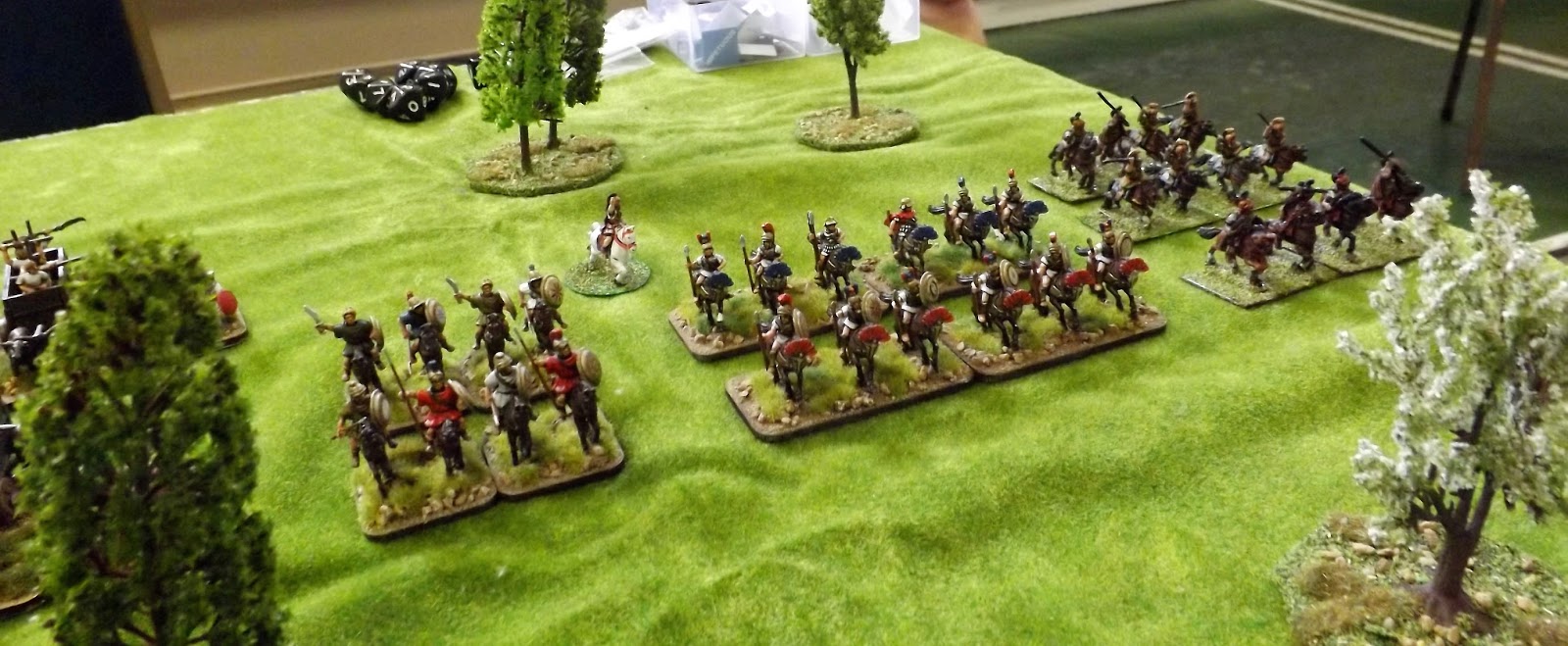
The Praetorian Guard cavalry are counter-charged by two Dacian warbands

Their simply wasn't enough time for the Roman infantry to bring their full force to bear which would probably have seen them victorious in another turn or two, time they did not get.

The Roman infantry, under heavy bolt shooting, press on towards the Dacian ridge line

So victory to the Dacians with the pass held and Trajan no doubt cursing over his delayed resupplies likely forcing the campaign to a close and his army into a winter quarters to await the spring.

Thanks to Steve L, Mr Steve, Mike and Nathan for a fun game using the new collection and to Nick for a resupply of tufts and flowers to garnish yet more bases and indeed the newest unit to join the collection, the Praetorian Guard cavalry, finished off that morning.

Sunday, 13 August 2017

Battle of Asculum 279BC - Augustus to Aurelian


This month the club was treated to a 15mm re-fight of the Battle of Asculum 279BC fought between the emerging power in Italy, the Roman republic and the Hellenistic mercenary army led by King Pyrrhus, invited into southern Italy by the Greek city of Tarentum in their struggle with the Romans to remain independent.

This period is very interesting in the development of Rome and its army as it is the first time that its forces went up against an Hellenistic army using tactics and forces that had enabled Alexander the Great to dominate the preceding era and would test the Roman system, coming up against massed pike phalanxes and elephants.

Pyrrhic War
Battle of Asculum

The rule set used for the game was an interesting choice as well, as followers of our club blog and JJ's Wargames will know that we have been play-testing Augustus to Aurelian (AtoA) rules by Phil Hendry for use with battles set in its intended era, the Roman Principate.

Fellow DWG member Nick was interested in trying the set out for this much earlier period in Rome's history where the formations and tactics can be somewhat different but the attraction of the core rules were enough to see if, with appropriate modification, they could be made to work with elephants and pikes.

The basic rules were, in our opinion, ripe for adaptation, with Phil already having included Phalanx rules into his original set to allow for Emperor Caracalla's pseudo-phalangites, to this Nick added a few other ideas including rules for Elephants and some modifications to the command system, which were only small changes to the core system.  After a test game away from club between Nick and Steve L to test the new rule additions we present the game played yesterday at this months club meeting.


http://toofatlardies.co.uk/product-category/avgvstvs-to-avrelian/
http://wargamesbuildings.co.uk/Augustus-to-Aurelian-Roman-Token-Set

Nick spent a bit of time producing and sending out the necessary briefings and positional maps so we could speed up the process of game set up once we got to club.

The map below shows the part of the battle of Asculum we were representing with the main Roman and Pyrrhic lines facing off against each other, whilst to the Pyrrhic rear right flank lay the Roman III Legion situated on a woody hill and threatened by large forces of Greek style hoplites supported by Pyrrhic cavalry.


The Roman battle plan assumed the Pyrrhic line would be keen to close  and attempt to overturn the Italian foot on the Roman right flank with their effective Samnite infantry supported by massed pikes to their right to help crush the Roman IV Legion and roll up the line.

To prevent any such manoeuvre the Roman command opted to attack in echelon bringing the Campanian hoplites supported by the IV legion in against the Pyrrhic right flank to turn and roll up the Epirote phalanx whilst using our secret weapon, the war wagons to fend off the Pyrrhic elephants as the cavalry attacked forward to link up with the III Legion as it attempted to break out off the hill and add to the pressure of the Pyrrhic right flank. The Roman right flank and the Italian foot would refuse the flank aiming to cause the Samnites to do a lot of marching that would see them hanging out in the wind as their line was rolled up by Romans and Campanians - what could possibly go wrong?

Below are the forces listed together with pictures of our initial set ups:

Battle Asculum Day Two Roman List

Roman Army Commander : Publius Decius Mus Level 4
·         2 x Medium Roman Cavalry

Roman Infantry Right Wing : Italian foot
·         Commander  Level 2 (C&C Rating 6)
·         2 x Leves Javelins
·         2 x Italian Medium Infantry Hoplite Long Spear
·         2 x Italian Infantry

Roman Infantry Centre : Roman IV Legion
·         Commander Level 3
·         1 x Leves Javelins
·         2 x Velites
·         2 x Hastati
·         2 x Principes
·         1 x Triarri

Roman Infantry Left Wing : Campanians
·         Commander  Level 2 (C&C Rating 6)
·         2 x Leves Javelins
·         2 x Campanian Medium Infantry Phalanx Long Spear
·         2 x Campanian Infantry

Roman Left wing : Roman Cavalry
·         Commander Level 2 (C&C rating 7)
·         1 x Medium Roman Cavalry
·         2 x Roman Cavalry
·         1 x Medium Campanian Cavalry
·         1 x Campanian Cavalry
·         2 x Light Cavalry

In Support Anti Elephant
·         2 x War Wagons
·         2 x Velites

III Legion
·         Commander Level 3
·         1 x Leves Javelins
·         2 x Velites
·         2 x Hastati
·         2 x Principes

View of the two lines looking from behind the Roman left flank with the III Legion out on the hill top left 

Battle Asculum Day Two Pyrrhic List

Pyrrhic Army Commander : Pyrhus of Epirus Level 4
·         2 x Royal Guard Cavalry

Holding force.
·         Commander Level 3
·         2 x Medium Epirote Cavalry
·         2 x Macedonian Cavalry
·         2 x Light Cavalry

In Support Elephant Force
·         2 x Elephants
·         2 x Light Infantry

Pyrrhic Epirote (Facing IV Legion)
·         Commander Level 2 (C&C rating 7)
·         2 x Medium Phalangites Infantry Pike Phalanx Drilled
·         2 x Phalangites Infantry Pike Phalanx
·         2 x Skirmishers Slings

Pyrrhic Greek (Facing  Campanians )
·         Commander Level 2 (C&C rating 6)
·         2 x Medium Hoplite Infantry Phalanx Long Spear
·         2 x Hoplite Infantry Phalanx Long Spear
·         2 x Skirmishers Javelins

Samnite Division (Italian foot )
·         Commander Level 2 (C&C rating 7)
·         2 x Medium Linen Infantry Long Spear (Small Unit)
·         1 x Linen Infantry Long Spear (Small Unit)
·         3 x Linen Infantry Pila (Small Unit)
·         2 x Light Infantry
·         1 x Leves Bows (Small Unit)
  
Supporting Force
·         Commander Level 3
·         2 x Athamanians Hoplite
·         1 x Acarnanians Hoplite
·         3 x Samnites Infantry

View from the Roman right flank with the white shielded Samnite infantry to right of picture with plenty of marching to do to get at the Italians on the left of picture

So with both armies set up we were off and the first chits were being pulled from the bag. AtoA uses a chit or card driven activation system common to many 'Lardy' style games and a favourite activation mechanism in the DWG club.

Better formations and leaders get more chits to make it more likely for them to activate first  and with AtoA this is incorporated with  'Carpe Diem' chits which start the game in the players hand representing better command and control before the armies come to grips when the commanders influence on matters starts to decline.

Pyrrhic cavalry face back and to the front with elephants in close support

The Roman command was keen to bring on the battle in the order they had planned for and so early play of these chits was needed to make this happen.

We had a large number of chits in play so to balance the game back towards that declining control, the chits would be returned to players but with only a 33% chance of getting them back.

The Epirote line of hoplites and Pikes

As the game progressed this lack of chits would become all too apparent for the Romans, but by then it was down to the soldiers to do their stuff.

Those elephants would be a problem as they were a new weapon to the Roman forces

The Roman plan started with mixed success as the cavalry came to grips first with the Pyrrhic horse getting the best of the first exchanges causing a few nervous glances from the legate commanding the IV Legion.

The III Legion prepares to break out

However, soon after, the Campanian hoplites struck at their Epirote opposition and after stiff fighting, that left both side shaken, the Epirote division was forced to retire from the line as its general rode about attempting to rally his men.

The Epirote hopiltes supported by cavalry prepare to attack the Romans on the hill

As the Campanians got stuck in, they were joined soon after by the first line of the Roman IV Legion as it closed on the Epirote phalanx in duplex acies formation.

However despite the volley of pila that struck the phalangites the Roman attack was held as the pikes refused to give ground.

Roman cavalry ready to attack towards the III Legion

With the infantry lines on the Epirote right going toe to toe, the Roman III Legion attempted to break out off the hill but a combination of poor chit draws and a lack of Carpe Diem meant that the Epirote holplites with support from copious amounts of cavalry were able to quickly amass on the Roman left forcing them to turn and fight.

The Roman line with Campanian hoplites closest to camera, then the IV Legion in the centre and the Italian foot top left 

The cavalry battle out on the Roman left degenerated into a typical to and fro affair until the Campanian mediums started to get the upper hand and driving in their Epirote opposition. But by this time events elsewhere had already started to make their efforts irrelevant.

The principle attack formation was the Roman IV Legion in the centre

The powerful Epirote phalanx

The Campanian infantry had done sterling work in initiating the Roman attack and taking their end of the line but the battle had left them vulnerable to counter-attack and that was when they were hit by the elephants.

The Samnite infantry on the Epirote left flank

King Pyrrhus leads his companion cavalry along the rear  of the Epirote line
The Roman attack begins with the echelon approach starting to take shape as the III Legion moves off the hill

The attack proved irresistible and the Campanians were forced to retire which left both the III and IV Legions exposed to attack in detail with little chance of any support soon.

The Roman right flank is refused with the Italians hanging back to cover the flank of the IV Legion
Battle is joined as the Roman and Pyrrhic cavalry joust on the flank nearest to camera
As the Campanian infantry celebrate success at driving in the Epirote hoplites they are hit by an elephant counter-attack. Where are those war-wagons when you need them? 

The Roman war-wagons were further back than intended due to the laborious movement rates of ox drawn wagons and thus despite the best efforts of the velites to shower the elephants in javelins the Roman left was forced back.

Pyrrhus leads his elite cavalry over to his threatened right flank 
The III Legion is thwarted in its attempt to get off the hill and link up with the Roman cavalry
Those Samnites are looking tired marching around on hot day like this

Meanwhile the Roman IV Legion was locked in mortal combat with the Pike phalanx as the Samnite hoplites closed on the Italian infantry with the threat of surrounding the Roman infantry unless they sought to break contact soon.

The Italians turn to face the Samnites as the Roman IV Legion hits the Epirote line

The Pyrrhic line had held firm and resisted the Roman attempt to turn it and thus we determined that with the Roman cavalry achieving a level of ascendancy of the Roman left, now would be the time for the Romans to start to break off and we ended the game there with a Pyrrhic victory.

Epirote hoplites mass against the Roman III Legion as it comes off the hill

The game had run along quite smoothly despite half the players not having played AtoA and the other half not having played for a while whilst also getting to grips with a few rule adaptations.

Nick and Steve are to be congratulated with coming up with some suitable additions to allow the rules to handle this period of Roman warfare and with my own collection of 28mm Roman EIR's and Dacian's about to be worked on I found myself eager to play more games with these rules together with thoughts about doing this period in 28mm Victrix plastics - now there is a thought!

Thanks to Nick for organising the game and all the DWG players for a very entertaining and fun afternoon of play.

Sunday, 9 April 2017

Tapae, 87 AD - Augustus to Aurelian


"A Dacian army raided the Roman province of Moesia during the winter of 86 AD. This attack proved the catalyst for a major Roman counteroffensive the next year that was personally led by the Emperor Domitianus. That summer a Roman expeditionary army commanded by Praetorian prefect Cornelius Fuscus crossed the Ister (Danube) River and entered Dacia, intent on reaching the enemy capital of Sarmizegetusa. The Dacians ambushed the Romans at a narrow mountain pass called Tapae (Iron Gate Pass), inflicting heavy casualties on the unsuspecting legions. The defeat resulted in the loss of arms and catapults, the destruction of a legion (the loss of a legionary standard) and the death of Fuscus.
Dio Cassius, Roman History, 67.6.5; 68.9.3; Eutropius, Abridgement of Roman History, 7.23.
From Roman Empire at War - Don Taylor.

So the April meeting saw us off with another (the third) game using Augustus to Aurelian rules by Phil Hendry, as we develop our experience with this rule set, with Mr Steve providing his 15mm collection of figures incorporating a few Marion Roman stand-ins and some ancient Britons reworked into some rather good Dacian look alikes.


Augustus to Aurelian

I (JJ) provided the terrain and my newly minted stat-cards and tokens to set the stage and run our game, which was taking the process on by allowing us to see how well the Dacians will perform with these rules.

Followers of my personal blog, 'JJ's Wargames', will know that I have started a collection of 28mm figures to model the Romano-Dacian wars and this was an opportunity to see how well the rules capture the essence of those campaigns.

JJ's Dacian Wars

So below you can see Fuscus' Roman column on the march through the Iron Gate Pass with the Dacians on either side ready to spring their ambush.

The forces fielded were roughly composed of;

Romans, 4 x Legionary & 4 x Auxiliary cohorts, 1 x Auxiliary Archer cohort, 2 x units of slingers, 1 x Auxiliary Ala cavalry, 1 x Auxiliary Light cavalry and 1 x Scorpio. Four Carpe Diem Counters.

Dacians with 12 x warband including 2 x Hardened warband, 1 x Falx warband, 3 x units of skirmishers, 2 x Sarmatian Cataphracts and 2 x Light cavalry. Two Carpe Diem counters.

Dacians, fouzands of em! I always think of this period of Roman Imperialism similar to 19th century Colonial Warfare

This was going to be a test for the Dacians as their army was split and thus the two warband divisions on the left of the picture above were outside command and control of the Dacian army commander and so were limited to working under their attack orders with little opportunity for those to change during the game and little opportunity for giving 'Carpe Diem' activations with the two counters held centrally by the Dacian commander.

For the Roman commander the issue would be the problem of sorting the column out into a fighting formation before the warbands closed in on the road from two directions with little opportunity to shake out into the classic duplex/triplex acies formation that would allow the cohorts to provide mutual support in depth. Not only that but the Roman divisions were on advance orders and new orders would need to be issued whilst reacting to the surprise attack.

The Roman line braces itself as the warbands charge down the slope

With Dacian warbands emerging from the tree-line either side of the narrow valley the leading Roman division of four cohorts coolly formed line to their left and advanced off the road to meet the Dacian division now fast approaching their line.

Behind them Fuscus personally brought up his second division to move up and behind his first along the road with his cavalry covering the front and rear of the column along with the artillery.

The rearward Roman division moves up to cover their comrades rear as Dacian warbands move in towards the road

The position was not ideal, he thought, and this was a large Dacian army but the Roman army had faced worst situations and still come out on top so with Fortuna's blessing there was no reason that this would yet be a good day.

The Sarmatian and Dacian cavalry division moves against the rear of the Roman column, taking hits from Scorpio fire.

The lead Dacian division seemed to cover the ground in no time and the front of the Roman column was drawn up in line ready to face off when with a roar three of the four warbands launched a fierce charge into the Roman line (Dacian warbands take an impetuosity test at the start of a new round if in charge range of the enemy normally requiring a 6 or less on 2d6 to maintain their control, and getting a plus one if they see one of their number charge forward).

The leading Roman cohorts reeled back towards the road in disorder as the ferocity of the charge hit their line.

Roman Scorpio crew calmly load their bolts as Sarmatian Cataphracts trot down the nearby slope
Meanwhile the second Roman division and the rear elements faced off the opposite side of the road as the Dacian commander was seen directing his elite division of cap-wearers and falxmen supported on their flank by Bastarnae Light cavalry and Sarmatian Cataphracts

Fierce fighting erupts as the lead Roman division struggles to hold the first Dacian attack
The fighting at the front of the column was not going in favour of Rome with the cohorts struggling to hold a line as the casualties mounted and the leading unit became shaken. Suddenly a shout went up as the lead cohort attempted to break away but was caught by the pursuing Dacian infantry scything down the Auxiliary infantry and causing the Roman light cavalry to break away as it evaded the oncoming rush.

Suddenly the lead Roman cohort is overrun and the Roman line looks vulnerable
If that were not bad enough the elite Dacian division struck the second Roman division with all but one of its warbands and with the falxmen leading the way hacking into the cohort to their front and causing four hits on their first attack.

As this assault caused the Roman line to reel yet again the leading division reached break point with, over half the cohorts shaken or destroyed, the formation reverting to 'Retire' orders forcing the units remaining to attempt to break contact which only encouraged the Dacian warbands to make further impetuous attacks as their battle rage grew.

One Dacian commander (Ian you are touched by the Devil) was unstoppable here rolling four d10 needing 5's or less to hit
With the front of the Roman column breaking up, the centre reeling under a ferocious charge by falxmen and cap wearers, the rear of the column was hit by Sarmatian Cataphracts, but started to give a good account of themselves as the Auxiliary Ala cavalry held their opposites as did the crews of the Scorpio's determined to defend their ground to the last.

Shaken (yellow and red) and Disordered (red) markers together with red mini dice showing hits flourish along the length of the Roman column
Fuscus knew the end was in sight as he dismounted and joined one of his centre legionary cohorts as they prepared to unleash a volley of pila at the onrushing Dacians.

His formations were a mess along the line of the road and the battle had broken up into huddles of resisters grimly hanging on as elements around them broke and tried to escape the carnage.

Cornelius Fuscus, like a true Roman General goes down fighting with his men as the falxes reap their gory harvest
As the second Roman division reached break point, the Sarmatians finally overcame the resistance of the Roman artillerymen and the Auxiliary cavalry who had put up an amazing resistance at the rear even as the remaining unused Dacian warband division closed in to seal the fate of Fuscus and his column.

Bitter fighting as the Sarmatians close with the rear of the column
As the battle came to an end with the Roman force destroyed to a man and with Fuscus joining them in their fate, the Dacian commander began the work of collecting up the weapons, armour and artillery that would be taken back to the capital as spoils of war, not to mention the Eagle found lying close by to the dead general and his staff at the centre of the Roman column.

Much fun with Augustus to Aurelian, I feel they really capture the essence of a particular period of Roman history and benefit from the focus they bring. Dacian warbands are quite different from their German cousins, who featured in the first two games, and the terrain and layout really influences how the armies fight.
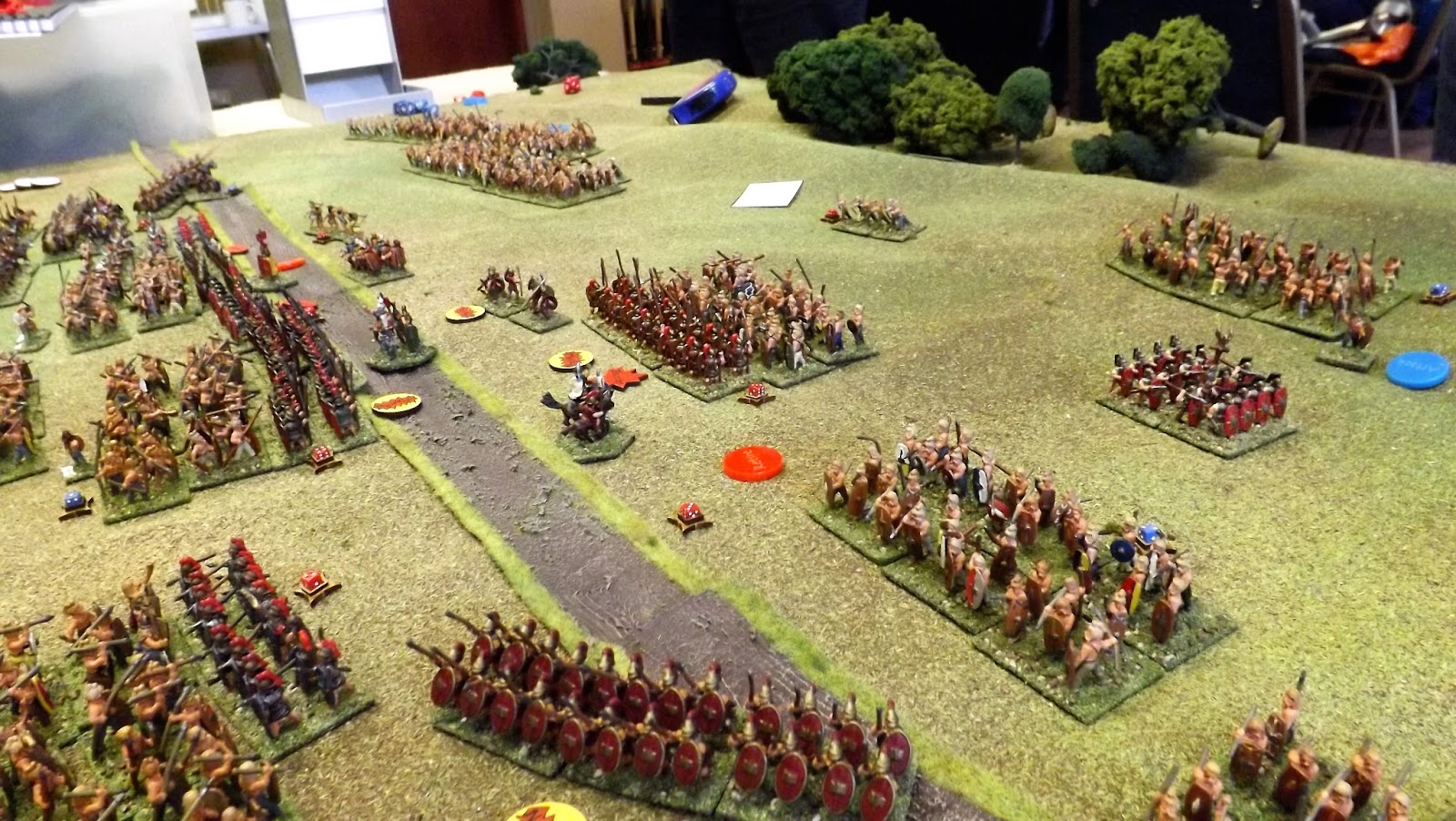
If you are a Roman you want a straight up fight in your favoured Acies formation and ideally with open ground and protected flanks. You don't want to be marching through German forests or caught in an ambush in column on a valley road. Thus these rules reward the effort to create scenarios rather than just two battle lines going toe to toe which they will also facilitate just as well.

The draw chits that replaced the cards seen in the earlier games worked like a dream with no dropped card decks as they were being shuffled. The chits were simply gathered up at the end of a turn and returned to the 'bag of doom' as the Romans saw it.

I can't wait to get started putting the 28mm collection together and found myself yesterday visualising the look of it based on our game yesterday.

For more information about the game markers and chits used, just follow the link to JJ's seen above which covers off all the posts too date about Augustus to Aurelian and the Dacian Wars project.

Thanks to Mr Steve, Ian , Steve M, Nick and Charlie for a thoroughly fun day topped off with a pleasant beer or two enjoying the spot of great April weather we are having at the moment.

JJ