Labels

Showing posts with label Sikh Wars. Show all posts

Saturday, 30 March 2024

Sikh Wars - Général d'Armée 2


Mr Steve dug out his Sikh Wars collection this week to entertain us with a game of the new Général d'Armée 2, (GDA 2) the follow up to the successful GDA 1 from Dave  and Christopher Brown and published by Reisswitz Press and available through the Too Fat Lardies web site.

https://toofatlardies.co.uk/product-category/reisswitz-press/general-darmee/

Much pouring over rules and crib sheets entailed as this was the first game of GDA 2 for some of us and the rules are still relatively new to all of us and so not surprisingly the play was not entirely intuitive, but from my own impression, having a copy of and having played GDA 1, much of the new set will be very familiar to those with a similar experience, with tweaks to various aspects such as the options for commanders and aide-de-camp tokens, the new scouting rules and pre-set brigadier command qualities for example.

This AAR will not attempt to give an overview of GDA 2, but rather an impression, this being my first go with the rules, and mindful that there are several very informative overviews of the rules in blog and video format that those interested can check out.


For our game, we had a straight forward attack (British) and defence (Sikh) encounter with both sides having a reinforcement potential later in the game, and seeing the Sikh line anchored on a small village, the British objective.


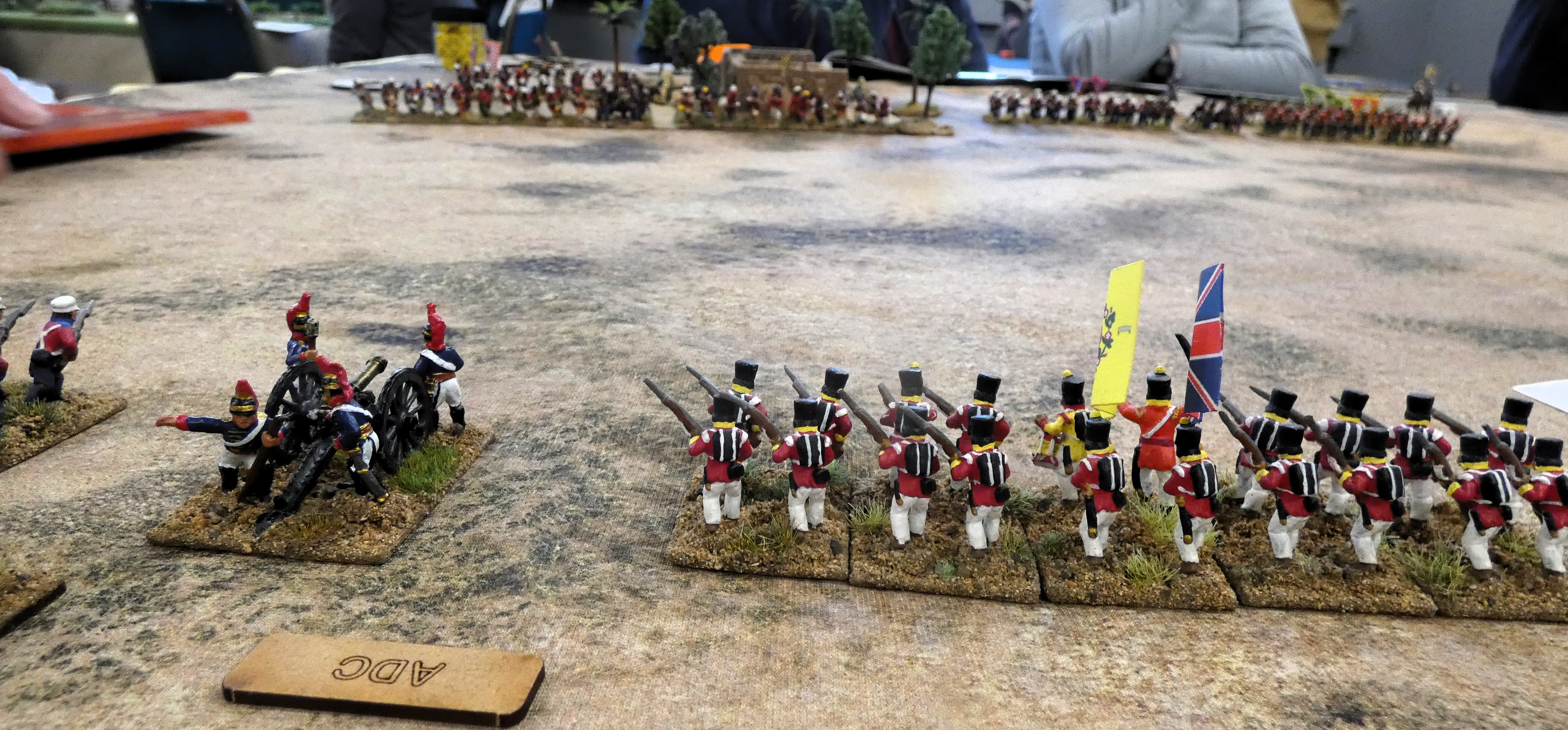
My chaps form up for the attack with my brigade deployed two-up (British line and a Sepoy battalion) and one back (sepoy battalion) and with artillery in the centre preparing the ground ahead. Note the ADC in attendance to make sure the advance gets going on time.

My determined opponents ready to repel the British and Sepoy attack

Our brave Brits and their Sepoy comrades boldly advanced with infantry on the left flank and centre supported by cavalry on the British right flank, mirrored by the Sikh army, anchored on the village.


The British pushed forward on the two flanks managing to draw Sikh infantry from the centre in support of their troops around the village, before the British reserves came up in the centre to make a hard push there instead.


Unfortunately for the British left flank the Sikh guns proved particularly effective and the attacking infantry was very shot-up before arriving before the enemy infantry positions and despite driving off one of the Sikh infantry units and battering their guns, were themselves driven back in disorder and dispersal having failed to make any impression on the defence.


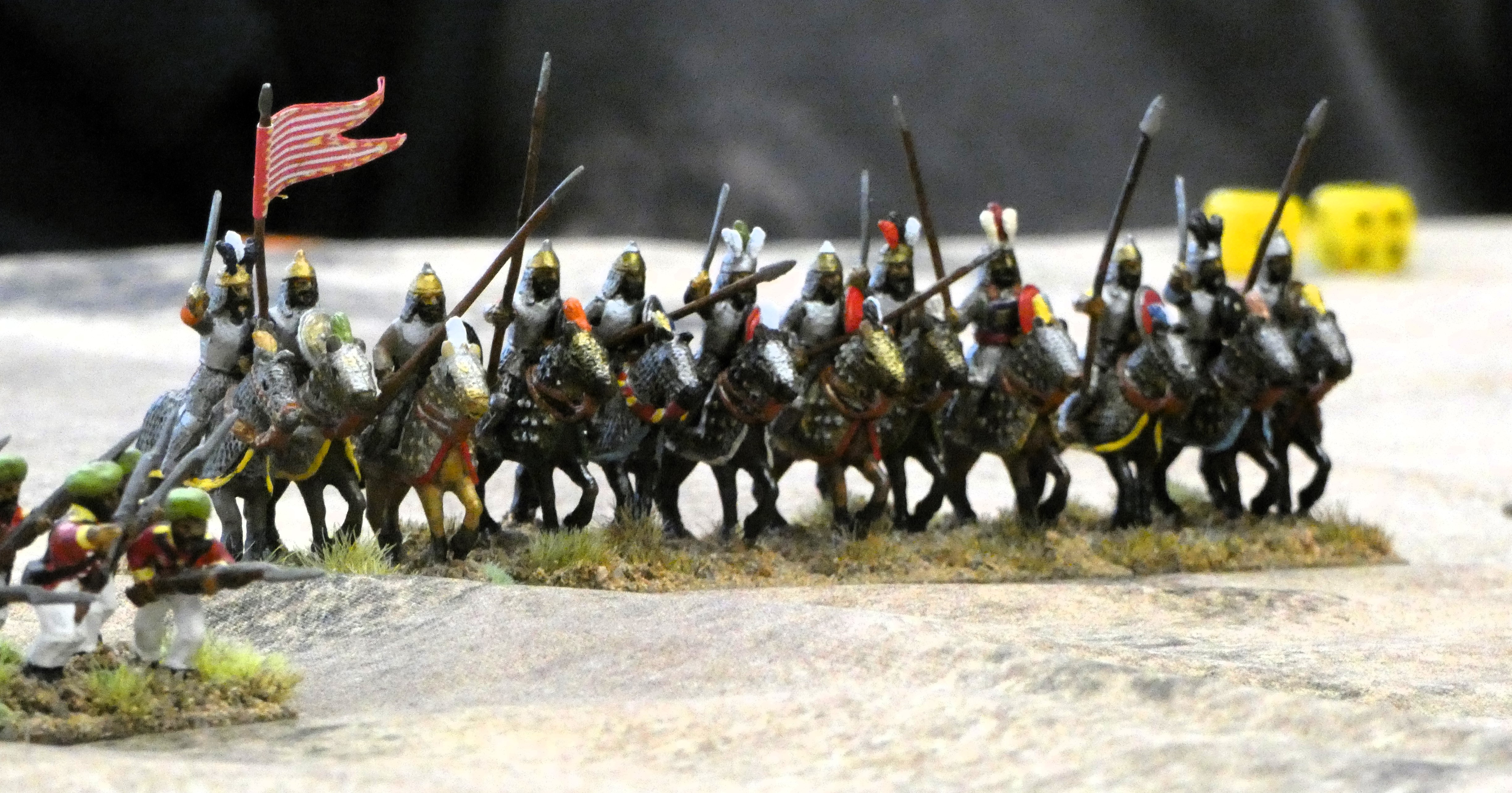
Similarly on the British right, the calvary had some early success, seeing the light dragoons defeat the first Sikh heavy cavalry regiment as it charged in, but then succumbing to the follow up counter-attack by the second regiment and causing the brigade to fall back.

As the British reserves pushed up to support an attack by the centre, the Sikh reserve moved on to reinforce the centre as the two British flank forces retired, leaving the British commander little choice but to forgo pressing the attack in the centre and calling it a day.


GDA 2 plays very straightforwardly with a entertaining play sequence of initiative determination, decision points on use of ADC's and the usual exchanges of combat dice rolls for shooting and melee that you would expect from rules produced by Dave Brown and are a good choice for a game at club with a few brigades on each side.

I would need to play them a few more times to comment on the more nuanced way of playing them, and we omitted the use of skirmishers which I would very much want to see in play in a horse and musket action, as they are very much part of any attacking force's 'softening up' tactic along with support from artillery before the attack force moves into contact.

Thank you to Mr Steve for a fun walk through of GDA 2 with something a bit different from the usual Napoleonic setting, all too familiar at club, and to Nathan, Ian, Ian Mc., Steve L. and Bob for making our game.

JJ

Saturday, 28 August 2021

Sikh Wars at the DWG using General d’Armee


Late at night the British commander finally received the message he had been waiting for, it was the details for all the Sikh forces movements in the next few days. It told him that a detachment would be sent out to secure a small well in a nearby village; he therefore put together a strong force to intercept and destroy them.


On arrival they discovered that the Sikhs had already secured the village and were now advancing onto the nearby high ground to confront the advancing British column, the British forces deployed into battle order and prepared to attack.


Using General d’Armee rules you get an agreed number of ADC chits each turn which can be used for various activities, you then have to roll to see how many are available for that turn. Usually at the start of the game the main use is for encouraging units forward and later in the game you might decide to instead add some to the artillery to enhance their firing or to the infantry/cavalry to give a bonus to melee etc. I gave the British six chits and the Sikhs only five to reflect the disloyal commanders and reluctance amongst the non-Sikhs.


With the heavy Sikh guns deployed on the hill there was quite an understandable reluctance for the British and their sepoys to advance which was reflected by my frequent ability each turn to throw a 1 or a 2 for the relevant brigades orders which classed them as hesitant (each turn you roll for each brigade a 3-6 means obey orders, a pre-allocated ADC chit will allow a re-roll), my adding an ADC just meant me throwing another 1 or 2 so I decided give up and instead to try and blast them off the hill with my 9-pounders. 


Two ADC chits will give you two extra dice that each has a 50% chance of an additional hit (no saving throws in this game). When using the firing table any really low rolls on your two dice will not only cause no casualties but will result in either fatiguing your guns or making your infantry fire become ragged; by enhancing your artillery firing, as I tried to do, you run the risk of inflicting even greater fatigue on your guns with a poor roll; queue a combination of rolls of 3’s 4’s and 5’s (with a -2 for shooting at guns not helping).


It wasn’t all bad, the Sikh guns whilst causing serious damage to some units had apparently forgotten to bring any ammunition with them as a series of double ones by my opponent were thrown on numerous occasions which meant a low ammo result for the concerned unit as well as fatigue, on each instance this was met with typical British indifference and absolutely no-one ran around the table with their shirt pulled over their head. 


On the left of the British attack the cavalry smashed through the Sikh irregulars and the Akali Fanatics who were holding that sector, plus overrunning the attached gun, and the whole brigade was destroyed (loss of ADC chit).


On the right a lone British 9-pdr potted away at a very reluctant Sikh cavalry wing that were clearly waiting to see who the winners were before plundering the losers. Inside that a couple of brigades advanced on what they hoped was a slightly weaker sector of the Sikh line whilst keeping a wary eye on the cavalry. The Sikh gun in this area was also unfortunately low on ammo but were backed up by a brigade of regulars who despite teetering on the edge of breaking flung back all the attempts to break through, with both sides casualties now getting close to having to take units off the table, one of the Sikh gunners suddenly remembered that he had some extra cannon balls in his spare jacket (2 ADC chits) so the British fell back.


To their left a lone Sepoy regiment attacked up the hill were there were no guns or Sikh regulars, this was the high water mark of the British attack, stopped by a Jagadari brigade (local warlords semi-trained troops) they tried to shoot them away, charge them away (“not to keen on that Sir”) and then looked hopefully over their shoulders for any support. None was coming!


Meanwhile the Sikhs having seen their right flank collapse countered this by redeploying another irregular brigade to stem the British cavalry and finally convinced the Sikh cavalry to get involved and so moved them behind the front line to the other flank. Some half- hearted charges combined with yet more hesitant rolls by me saw the British Cavalry threat disappear.


Suddenly the word “PUB” was heard from the flanks, looking around both players realised that they were the last game playing so a draw was quickly agreed and rapid packing up commenced however the British were in no real state to have pushed the Sikhs off the hill so they would have withdrawn anyway.


I have been looking for some time to find rules suitable for Sikh wars and out of the many, many sets tried these are the best yet. I liked that I could fit in all the relevant units from the Sikh wars to the terms used in the rules without too much trouble, I also liked the way that unit effectiveness degraded as casualties mounted or by increasing fatigue/hits if artillery. 


Having played and owned the ACW version, Pickets Charge, I was already familiar with and liked the use of ADC chits, movement and the command methods, I recall that I wasn’t convinced at the time about the way firing and melee was done when I played the ACW set, now, after a couple of games using the very similar Napoleonic version, my only remaining concern is about the melees but cannot tell you why so don’t bother asking.

Thanks to Dave for playing and for throwing so many double ones.

Figures: 1/72nd Newline Designs
Cloth: Zulu mat from Tiny Wargames
Trees: Woodland Scenic’s
Buildings: Hovels
Rules : General d’Armee available from Two fat Lardies

This has been a Mr Steve production.

Saturday, 17 February 2018

Sikh Wars 1845 - A TSATF Scenario loosely based on the Battle of Mudki


Another of the games at the February meeting of the Devon Wargames Club was one I put on using my new 1/72nd Newline Sikh wars collection and was very loosely based on the Battle of Mudki 1845 (so loose that the best that could be said for the accuracy is that Sikhs and British were involved).


I have been looking for some time to try and find suitable rules that have the magic mix of gameplay and period character but without success , the nearest I have come is with ‘Flames in the Punjab’, a spin off from The Sword and the Flame skirmish rules by Larry Brom. This supplement was written for battalion level games especially for the Sikh wars but still uses many of the original rules from TSATF (both sets are needed). I bought my copy from Sergeants 3 but forgot to buy the original set.


http://www.sergeants3.com


I liked many of the concepts from the rules but decided to re-write a set from scratch using what I liked and inventing the rest, the result was five pages of A4 and I tested them safely away from club just to make sure that they worked, which I was pleased to see that they did. Some tinkering resulted in version 2 which was used in this game (Version 3 has replaced them, still on five pages but the font is getting smaller)


The British had been informed that a small force of Sikhs were approaching from the Mudki area and so quickly deployed onto the plain in front of their camp, the main Imperial army was still assembling from all the corners of India therefore this advance force were under orders to not stray to far forward however only an absolute bounder would refuse an opportunity to fight and so upper lips were made suitably stiff.


The British consisted of three infantry brigades, one HM battalion and two Sepoys per brigade with artillery attached to each accordingly. The cavalry consisted of the 3rd Light Dragoons, Governor Generals Bodyguard and the 5th Bengal LC.


The Sikh force was a bit more mixed, there were six battalions of Sikh infantry split into two brigades, a three mob brigade of irregular infantry, a unit of Akali fanatics and a unit of Jagirdari feudal infantry. The cavalry was made up of a single unit of Sikh dragoons, one lance armed Ghorchurra (this term is also applied frequently to the everyday cavalry) and two irregular units .


Both sides being both unfamiliar with the rules and the forces involved just sat there for a long time using only their artillery to relieve the tedium until I eventually found the correct voltage on the encouragement wand to make them advance.


As the Sikh artillery had by now gotten the worst of the exchange their whole force advanced all along the line, sending the cavalry rapidly forward on their right wing and the irregular infantry pushed through the jungle (a 19th century description for what we call woods, shrubs and bad going).


First into action were the light dragoons and the Ghorchurra who both strived tirelessly to not win the melee, the Sikh dragoons advancing next to them got badly mauled by the Sepoys holding that end of the line and who had obviously been paying attention at firing practice because they handed out more of the same to the Jagirdari infantry, eventually the Ghorchuras failed their morale and threw high enough that any remaining figures were taken straight off the table however by that time the irregular Sikh cavalry had joined in pinning the British dragoons. The remaining cavalry had all started their own melees with weight of Sikh numbers holding the better Sepoy cavalry. (version 3 now has a three turn melee limit) .


Ignoring the irregulars pushing through the jungle the British right wing hurried across to help their friends who had been getting the worst of the fire fight, the Sikhs had skilfully arranged their forces so that they would all throw very lucky dice when shooting and the British line was starting to look shaky especially the Sepoys.


The far left Sepoy battalion had now obviously forgotten what they had learnt at target practice or were distracted by the shiny metal quoits whizzing towards then as they only managed to hit one of the charging Akalis even at short range .


The hard pressed British centre looking to their left were dismayed to see their potential saviours had now stopped and were trying to shoot to a halt the charging Sikh irregulars who had finally traversed the jungle . Despite their poor starting morale only one unit was sent packing and the others raced into melees that forced a Sepoy battalion to retreat.


By now the other two British brigades were badly damaged with two units already taken off the table and the rest were down to a level where you don’t want to hear the word morale throw. The Sikh regulars, although showing signs of wear, clearly had the upper hand and could still maintain an unbroken line.


The final turn saw the British artillery that had been trying to desperately plug huge gaps in the line get shot to bits and with another battalion destroyed it was time for flags to be hurriedly taken of poles and given to a horseman to ride rapidly away with.


I wrote the rules written to encourage forward movement and I think the players involved would do things a bit different next time. The sides are quite even and although the HM infantry are good it isn't by a lot so they cannot sweep away colonial forces as in most games.


The game also raised a few possible improvements and some things that I hadn't even considered and have now been added into the rules or clarified a bit better and I suspect there may well be a version 4 at some time after a few more games however they did hold up for our game, which was nice.


My thanks to Nick, Steve H and Mike and it was nice to see a returnee to the club from long, long ago, who frankly we all thought was dead, fortunately he is also called Steve so that’s all right.


Figures: 1/72nd Newline Designs
Cloth: Zulu mat from Tiny Wargames
Trees: Woodland Scenic’s
Buildings: Hovels


This has been a Mr Steve production.