

Introduction
This year marks the one-hundredth anniversary of the deaths of the two competing architects of post-World War One “Global Order”. Woodrow Wilson (28th U.S. President) and Lenin (Vladimir Ilyich Ulyanov) both passed-away in 1924. Lenin died on twenty-first of January and Woodrow Wilson on the third of February, less than a month apart. A Russian Civil War game involving both Russian and United States forces, at the Devon Wargames Group, beckons!
 |
| Vladimir Lenin & Woodrow Wilson |
Background
When Trotsky negotiated peace with Germany, the entente powers sent troops to intervene in Russia; they wanted Russia in the war. U.S. troops were sent to Archangel and Vladivostok. President Wilson’s instructions were: safeguard the military stores, assist the 70,000 strong Czech Legion to leave Russia, and avoid intervening in Russia’s internal affairs but aid Russia’s Government or its self-defence
(diplomatic speak for aiding pro-entente Russians).
President Wilson also wanted to counter Japanese ambitions. The Japanese success in the Russo-
Japanese war of 1904-05 and a weak Russia, was an open invitation. Japan was the first country to
intervene and their force soon expanded to 72,000 men in Siberia.
 |
| Allied soldiers and sailors in Vladivostok, September 1918. |
Initially the Russian Civil War was largely confined to European Russia; Siberia was largely untouched.
War however, does not mean revolution and much of Siberia was under the Bolsheviks’ rivals, the Mensheviks. The Bolsheviks and the Mensheviks were factions in The Russian Social Democratic Labour Party; The RSDLP had split in 1903, into these two factions. Whatever their differences, when it came to foreign interventions, they were both on the same page. The Mensheviks were popular with the Siberian peasantry as land redistribution was one of their policies.
Menshevik control of Siberia meant a campaign from Siberia into European Russia was a non-starter. In November 1918 the entente powers organised the overthrowing of the “Siberian Provisional Government” replacing it with a military one, under Admiral Kolchak. The Admiral’s government had the same short comings as other White factions, it did not have a reformist programme. The peasantry were set upon by the Czars traditional enforcer, the Cossacks, often with Japanese assistance.
 |
| Admiral Kolchak decorating some of his troops. |
The Admiral’s forces enjoyed some success, as they had access to the war materials in Vladivostok. But as the campaign progressed, he found increased difficulty in recruiting soldiers to his army from the peasantry. Many of the peasants withdrew into the forests and formed large partisan groups, which then attacked the Trans-Siberian Railway (Transsib) and his other supply lines. As more of Kolchak’s troops were diverted to security duties, this began to tell on front-line operations.
Once fighting on the western front stopped, The Czech Legion who effectively controlled the Transsib railway stopped fighting the Bolsheviks. Interventionist troops had to assume responsibility for the Transsib and the all-important coal mines. Notwithstanding interventionist assistance, the Admiral’s campaign against a now invigorated Red Army failed.
 |
| Trans Siberian Railway. |
By January 1920 the Admiral’s forces had retreated to Irkutsk and The Czech Legion handed over Admiral Kolchak to the Bolsheviks, in exchange for safe passage along the Transsib. The Circum Bhikal section (4 on the map), was is the most difficult sections of the Transsib with over thirty tunnels and many viaducts etc. The Legion had had to fight hard to secure this section and if it was recaptured
by the Bolsheviks, there escape eastwards would be next to impossible.
 |
| Circum-Baikal section under construction. Tunnels, viaducts, culverts etc allow the railway to hug Lake Baikal. |
The Czech Legion
The Czech Legion was recruited from the two million Austro-Hungarian prisoners of war in Russia. The Legion was to go to France as part of the French army and post war, when the Austro-Hungarian Empire was dissolved, they hoped for an independent Czechoslovakia. Lenin agreed to the plan and recruits were soon concentrated along the Transsib. Then Lenin changing his mind and the Bolsheviks opposed the Legion’s progress along the railway. Over a three-month period, by a combination of daring-do and raw courage, the Legion got control of Transsib east of the Urals. But with the 1918 armistice, the legion and just wanted to get to their new homeland.
 |
| Czech Legion and one of their trains, 1918 |
The legion’s success have two unexpected consequences:
- The formation of The Red Army, as Red Guard were inadequate to stopping a determined enemy, and,
- The execution of the ex-Czar and his family because of fears that the Legion might free them.
U.S. Intervention in Siberia
 |
| American soldiers in Siberia, December 1918 |
Eight thousand troops, under General Graves, were sent to Siberia in August 1918. With the armistice in the west and the Czechs now neutral, guarding the Transib so supplies could reach the Admiral’s army, now fell to the interventionists. With the armistice with Germany, overthrowing the Bolsheviks so Russia could rejoin the war, was pointless. De facto the U.S.A. was now a participant in the civil war on the side of the Whites. Following the defeat of Admiral Kolchak, the U.S. troops withdrew from Siberia in early 1920.
Japanese in Siberia
The Japanese landed in Siberia as an interventionist power but the size of their force belied their real intentions. Japanese troops operated as far west as Lake Baikal and tried, but failed, to set up a proxy state in east Siberia. Japan withdrew in 1922, retaining the southern half of Sakhalin Island, which the U.S.S.R. took back in World War Two.
 |
| Japanese troops in Siberia |
Today’s Scenario – Near ONOKHOY Railway Station, Siberia
With the collapse of Admiral Kolchak’s campaign in Siberia, the focus of events is moving eastwards. The White forces and their Interventionist backers are retiring and the Red forces are following on their heels. The difficult Circum-Bakal section of the Transsib is back in Bolshevik hands as the Czech Legion withdrew. The protagonists include The U.S.A., Japan, Bolsheviks, Partisans, Czech Legion and whoever else happens to be in the area; the belligerents are mutually suspicious of each other. The Japanese want to set up a proxy state. The Czechs have an uneasy cohabitation with the Bolsheviks but they won’t let anybody stand in their way. American soldiers are demoralised as they have been stuck in Siberia for two years. The partisans hate the Cossacks and visa-versa. Trotsky’s prestige rides on the success of the new Red Army or he will lose his job to Stalin. And the Bolsheviks suspect the Legion has seized part of Russia’s gold reserves too.

BOLSHEVIKS and SOCIAL REVOLUTIONARIES (LEFT))
Bolsheviks One

1 Senior Leader + 2
2 Junior Leader +1
3 units of 10 riflemen with bombs C3 M3
1 unit of Red Cadets 8 riflemen with bombs and 2 LMGs C3 M2 ferocious
1 unit of cavalry 8 men C3 M4
1 unit of red Cossacks 8 men C3 M3 ferocious
2 Machine Guns C3 M3
2 75mm Artillery C3 M2
Bolsheviks Two

1 Senior Leader + 2
2 Junior Leader +1
3 units of 10 riflemen with bombs C3 M3
CHEKA special squad 8 riflemen, bombs, 2 LMG’s C3 M4, - can be used as normal combat unit or as a blocking unit. To block, the figures are spread out max 3 inches apart and block any retreating Red unit, of any red player.
1 unit of cavalry 8 men C3 M4
1 unit of red Cossacks 8 men C3 M3 ferocious
2 Machine Guns C3 M3
2 75mm Artillery C3 M2
Partisans and Workers (Social Revolutionaries (Left))

1 Senior Leader +1
4 units of 10 partisans with rifles (no bombs) C4 M3 ferocious
1 unit of 10 cavalry C4 M3 ferocious
Angry mob of sawmill workers C5 M4 ferocious
INTERVENTIONISTS
Japanese Forces

1 Senior Leader +2
4 junior Leaders +1
3 units of 10 riflemen armed with bombs. Competence 3 Morale 3
1 regular cavalry 8 men C4 M3
1 special infiltration unit of 8 rifle men with bombs C3 M2
2 irregular cavalry 8 men C4 M4
2 Machine guns C3 M3
2 mountain guns C3 M3
USA

1 Senior Leader +2
3 Junior Leaders +1
3 units of 10 rifle men with bombs C3 M4
1 unit of 8 trench brooms with bombs C3 M3 ferocious
2 units of Light Machine guns C3 M4 stubborn
2 Machine guns C3 M4
Some defensive positions
Czech Legion

1 senior leader + 2
3 Junior Leaders + 1
2 units of 8 shock riflemen with bombs C2 M2 ferocious
2 units of 8 riflemen with bombs C3 M2 stubborn
3 Machine guns stubborn
1 armoured car
Train with unknow contents.
Rules

The rules used are “Setting the East Ablaze 3rd edition, with some minor modifications. In the main
rules each unit has a separate card for its activation. Once drawn from the pack the unit is activated,
but I have reduced the number of cards allowing for some differentiation in command and control
between the protagonists. Each player has five cards which they can use to activate units or leaders
of the same type if they are regulars (infantry, cavalry etc.) Irregular troops need one card per unit or
leader. We used simple playing cards and players activated their units in the sequence of the cards
they held – with aces as wild cards. (Editors Note - we got tired of messing about, shuffling playing cards, so you will see we started using the playing-card symbol chits instead).
How the Game Played
“How Joseph Stalin Got His Moustache”
Stalin The Tank Engine pulled into ONOKHOY with his last puff of steam; the wagons and coaches had grumbled all the way from Irkutsk. Boris the buffet car was drunk, Fiadora the flat-bed sang the International poorly because she couldn’t hit the high notes and Georgi claimed to be the famous sealed carriage that carried Lenin across Germany (which can’t possibly be true because German and Russian railway gauges are different). As soon as Stalin stopped the Czech Legionnaires started to coal and water him, before emptying the station cafeteria and bar. Boris was happy seeing all the bottles of intoxicating beverages heading his way.

The Red Controller sent Skinny Oleg to the near-by sawmill, where his uncle was something important in the local Works Soviet. Soon workers and armed partisans streamed from the sawmill towards the station shouting “Stop the train” and “Block the track”. Even the cart horse became adhoc cavalry. Stalin was happy to see the commotion; after the long trip from Irkutsk a restful delay was fine with him.

Captain Lyman of the U.S. Army was happy to see Stalin too; he knew this was the last train load of Czech Legionnaires. His mission was to keep the railway open for the Czechs and then he could go home. Captain Lyman had left his father’s haberdashery business to fight the Germans in France but two years after the armistice, he was stuck in Siberia. Stalin was happy to help the American passengers but only after a bit of a rest.

The Czechs didn’t like the look of sawmill workers and they unloaded their armoured car. They had one of those new British types, not just with a machine gun but with electrified bodywork too; if anybody touched the shiny paintwork they would get a good zapping. The Czechs had good reason to not delay at ONOKHOY because they knew Mr. Trotsky’s new model Red Army was hot on their heels. Before leaving Irkutsk, the Czechs had emptied the bank vaults of all the gold. Mr. Trotsky very angry and had sent his friend Felix to chase after the Czechs and get the gold back. Felix wasn’t the kind of man to mess about and he blew up the armoured car right away. This made Felix and his comrades very happy but the Czechs were now very angry.

Captain Lyman realised that things weren’t going as smoothy as he hoped. Soon his men were shooting at the sawmill workers because his President, nice Mr. Wilson, had ordered him to keep the railway line open for the Czechs. The Czechs joined-in too, so that made it alright. The sawmill workers took cover amongst the stacks of logs and planks waiting for their opportunity.
Colonel Wanatabi of the Japanese Army, was marching hurriedly towards ONOKHOY. His Emperor had seen how nice Mr Wilson was giving away bits of the world to anybody who asked politely. Before there were Empires, now there were lots of new countries like Iraq, Yugoslavia, Syria and Estonia. The Japanese Emperor wanted to join in the fun and make some new countries in Northern China and Siberia. But Mr. Wilson had said no to the Emperor and Colonel Wanatabi had orders to shell the U.S. Army camp in ONOKHOY, because it was nearer than Hawaii.

Soon everybody was shooting at everybody and Stalin took a quick kip until things were sorted-out. Even people on the same side wanted to shoot at each other. Mr. Trotsky had recruited some Cossacks for his army and the sawmill workers hated Cossacks. Once upon a time the Cossacks had been very nasty to the people of ONOKHOY. Only the intervention of Skinny Oleg’s uncle stopped the sawmill workers shooting at the Cossacks.

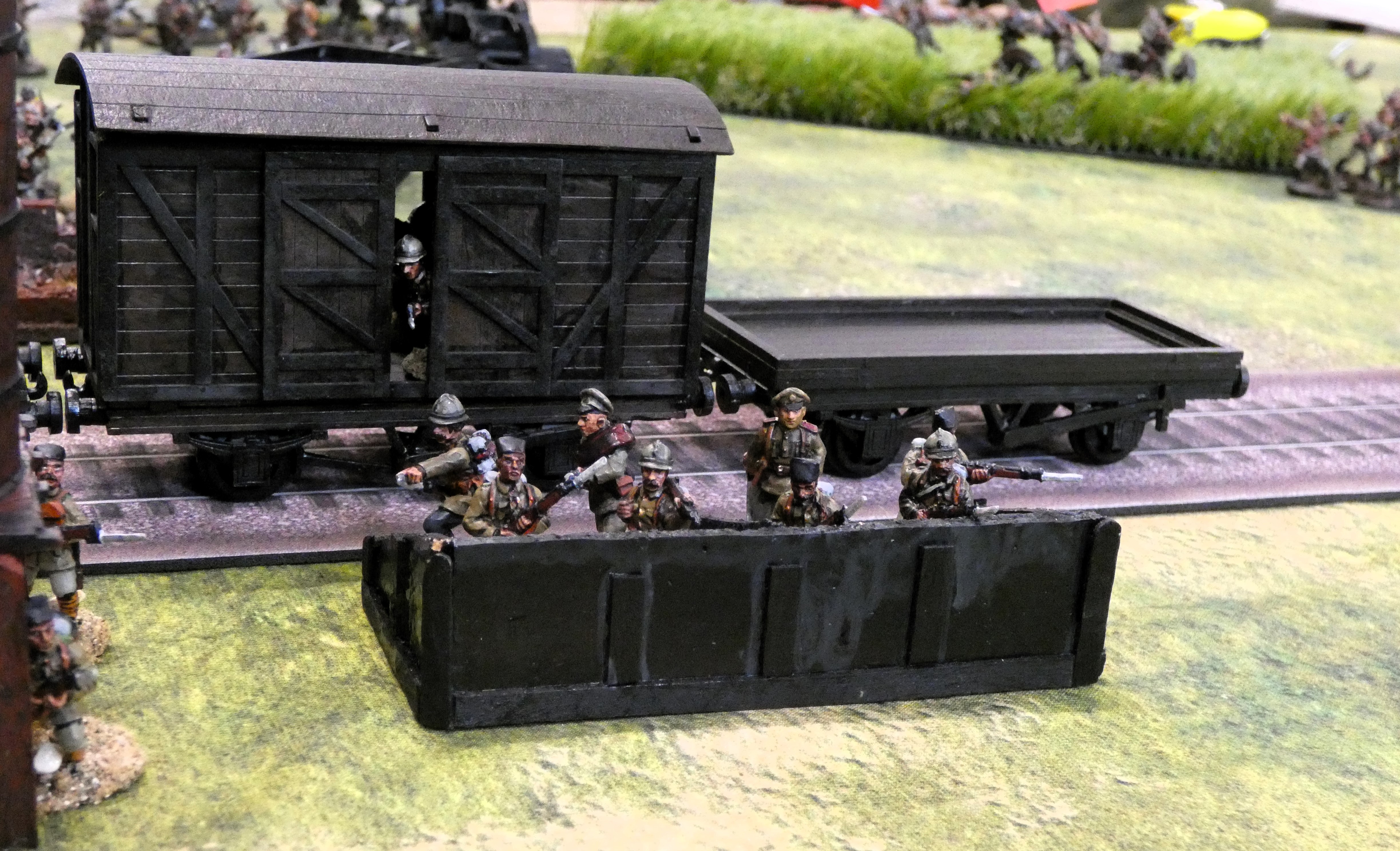
Captain Lyman sent some of his men to secure the railway station but they discovered some Japanese, in funny disguises, had got there first. A heck of a fight broke out and only ended when all the Japanese were dead. Mr. Trotsky’s Red Army pushed forward relentlessly shooting and shelling everybody. The Czechs used their Maxim guns on anybody who looked Russian. Captain Lyman got out some Thompson guns and introduced the Japanese to an average Saturday night in Chicago.

Stalin woke-up in a terrible hot sweet; a huge amount of coal was being shovelled into his fire box and his boiler was filling with steam. Stalin could see the sawmill workers approaching the track with large logs and timbers determined to block the line. With a reluctant lurch he moved forward, knowing it would hurt if he hit something. Behind him angry passengers were shouting, in a multitude of languages, at being left behind. Boris said it was alright because the bar was now restocked with drinks and snacks. Captain Lyman was angry, the Red Controller had reserved a him a first-class seat but he was still in the U.S. camp, being shot at by the Japanese. Help came from an unexpected direction as some of Mr. Trotsky’s cavalry charged the Japanese, chopping them in bits.
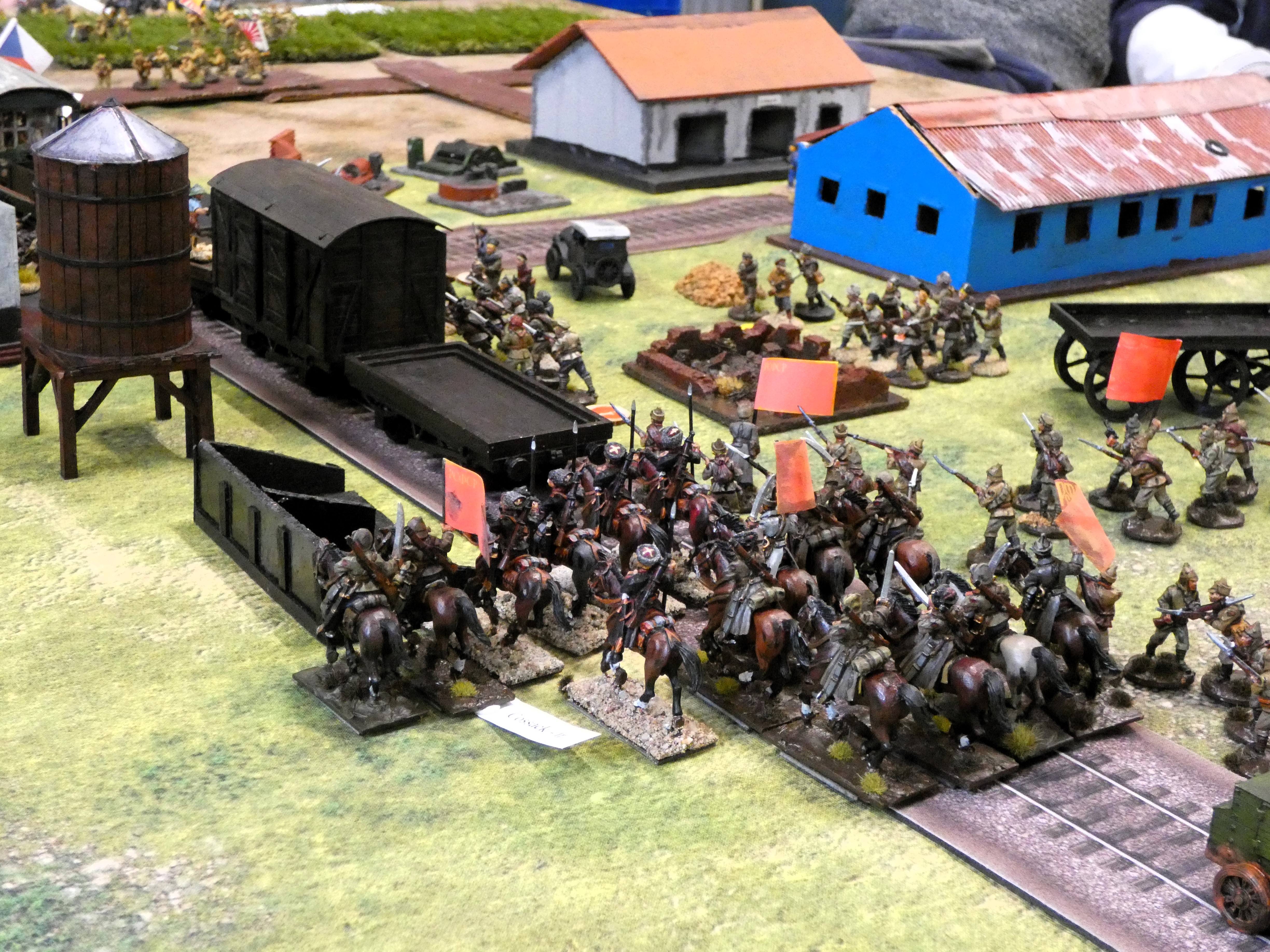
Still Stalin worried about the obstacle ahead. As he got closer and closer the logs loomed bigger and
bigger; a crash and derailing could be the end for him. Stalin knew Russia was an atheist country
now but he prayed anyway. His prayers were answered by Arkwrightski the driver, who slammed on the brakes. Vlad the fireman flew across the cab and shouted unrepeatable oaths because a large lump of coal hit him in the face. Just in time Stalin managed to stop. Arkwrightski started shouting in Russian but everybody knew what he meant “Clear that obstacle or we’re going nowhere”. Vlad helpfully pointed out that that wasn’t strictly true, they could still go backwards but a glare from Arkwrightski silenced him.

Captain Lyman’s trained his two Browning 0.30’s on the sawmill workers at the railway obstacle, but
try as they might they couldn’t hit anybody. Some of his men, assisted by some very keen Czechs,
went to clear the obstacle but the Japanese kept shooting in a very unhelpful way. By now Felix and
his men were all over the railway station and the train; even the ad hoc partisan cavalry managed to
charge the Czech maxim gun on Fidora the flat-bed.
When Felix opened the sealed goods-waggon doors he saw that Mr. Trotsky was right; the wagon was chocker-block with bullion and sacks of gold coins. There was so much gold that Mr. Trotsky and his family could afford to emigrate to Mexico, which is much more sunny than Siberia and the food tastes better.

Stalin The Tank Engine became national hero through-out all of Russia, for patriotically not escaping to the East. His fame was so great that one of Russia’s new leaders, Joseph, adopted the name Stalin in his honour. Joseph grew a big moustache just like a tank engine’s front rail and bumpers. Colonel Wanatabi and Captain Lyman had to quickly settle their differences and retreated eastwards. The Czechs were being sent to a holiday camp on the Kola Peninsula.
Felix was disappointed to receive a frosty reception when he returned to Moscow. He was summoned to Joseph’s office where he was shown a big map of Eastern Europe. Somewhere between Warsaw and Minsk there was a thick red crayon line. Nice Mr Wilson had decided that Warsaw wasn’t in Russia anymore and he had made up a new country called Poland.

Joseph told Felix that because he came from the other side of the crayon line, so he wasn’t Russian and better pack his bags and move to Poland pronto. Felix moved to Poland and remembering Stalin, the plucky little tank engine, decided to became a train driver. Then Felix joined The Railway Workers Union and was soon organising strikes all over Europe.
Stalin The Tank Engine was moved to a shiny new shed in Red Square, right next to Lenin’s Mausoleum, where you can visit him next time you are in Moscow.

With apologies to Rev. Wilbert Awdry, Thomas and his friends.
Sources
The forgotten story of American troops who got caught up in the Russian Civil War by Erick Trickey,
Smithsonian Magazine.
The battle of Lake Baikal by Kevin McNamara, History Net.
The Russian Civil War 1918-1921 edited by Bubnov, Kamenev, Tukachevskii and Eideman; translated
by RW Harrison, Casement Academic. Despite the rather turgid prose, this is probably the best account of the civil war written in Russia during the Soviet Union period. Three of the four editors were executed in Stalin’s purges and the fourth had the good sense to pre-deceasing.
The Russian Civil War 1918-1920 by D Bullock, Osprey Publications
Various internet open resources
As a general comment, I highly recommend this documentary “Paris 1919”, for anybody interested in this highly significant era in world history.
Miniatures and Terrain.
Locomotive and rolling stock – Sarissa Presision.
Miniatures Copplestone Castings, Empress Miniatures and Woodbine Miniatures.
Buildings – some Sarrissa buildings but mostly DIY made from cork tiles. Railway track by Little Wars.
Thanks
Thanks to JJ, Liz, Mark and Mathew, Vince, Tom and Chas (who supplied the U.S. Army and understood the rules better than me) for playing in this chaotic game. If anybody thought they understood what was going on, then they didn’t understand.
Stephen Huntsman


