|
| LM326 EM-Z of 207 Squadron pictured over Barkston Heath airfield Lincolnshire in 1943 |
It was during last month's trip to Holland, whilst visiting the Museumpark Bevrijdende Vleugels in Best which houses among its very interesting collection of WWII vehicles, aircraft and other associated exhibits an array of various WWII aircraft pieces from the many crash sites to be found in the Netherlands.
Museumpark Bevrijdende Vleugels
As you would imagine there were several Lancaster crash sites included in this exhibition and I was reminded by Tom about a game we used to play with him and his brother Will, called 'Target for Tonight' after the famous Academy Award winning WWII film/documentary of a particular raid in 1941.
Target for Tonight
I picked these rules up a few years ago now after watching the game being played in Plymouth and written by D.W.Thomas in 2000, I do not know if they are still available with a quick Google search revealing nothing.
As you can see these rules don't come in glossy colour with lots of pictures of models and painting guides, just a straight forward set of black and white rules, just how they used to be! These rules are simple but not simplistic and give a very good sense of the process of a night bomber raid from take-off to landing and might be described as a "beer & pretzels" approach to the subject. I have always found them fun to play and so was happy to dig them out and get the toys together to take to club.
The game is described best suited for play solo or with a large number of players, say six or so, and I have found it quite straight forward for a player to handle multiple aircraft, in fact in our first game when I umpired, Ian, flew five aircraft using the different record sheets to note information on each plane as we went.
The idea is to play a raid from the bomber crew's perspective and it plays through a series of events:
- Take off
- The initial climb to the coast
- A sustained climb over the North Sea
- Enemy Coast Ahead
- The Kammhuber Line
- A number of legs over occupied Europe and Germany
- Flak zones before the target - three for the Ruhr and Berlin with others having one or two zones
- Over the target
- Homeward bound
- Descent over the North Sea
- Return to base
- Landing
Each of these stages is represented by the tiles you can see in the picture below and the bombers progress from one to another until they are lost or are safely home. Of course each part of this progression into the mission carried risk for the planes and crews involved and thus on moving from one stage to the next a series of D10 die rolls are made by the player and umpire to assess whether a risk to the plane occurs and the result of damage picked up through the flight.
 |
| The target for tonight gentlemen is Derben - RAF bombers and Luftwaffe night fighters set up to do battle over occupied Europe. |
The general idea is that any time a '0' is rolled is when everyone starts getting nervous, and shouts of 'night-fighter!' and 'look out skip!' are the rule, with usually a roll of about 5, 6 or less being good enough to progress without any issues.
As well as the risks involved the die rolling also takes care of the occasional 'cock ups' that would occur with flying long distance at night and the issues for navigation and maintaining the aircraft, not to mention a comrade flying in the bomber stream colliding with, or dropping a bomb on, you.
The D10 also controls night-fighter activity in appropriate zones together with accrued damage causing the affected aircraft to roll single or multiple D10's from zone to zone from when it occurred to see if the damage has caused a fatal problem for the aircraft requiring the skill of the pilot to overcome. This again is only a concern when a '0' occurs but multiple damage is always a constant threat during a flight.
Surrounding the raid is the planning and preparation leading up to the crew briefing with players encouraged to get into character and the parlance of the day with references to "home in time for eggs and bacon" and the occasional "wizard prang".
Thus the map for our mission shows a raid planned on Derben, deep into Germany where the city was a target for oil refining and other associated production. The legs of the flight are shown with the approach over the North Sea before the turn to target.
The course seeks to avoid other key targets and their associated flak concentrations and two secondary targets, Kassel and Giessen are indicated should the crew miss the intended target and need to dump their bombs productively.
Aspects such as spoof raids and pathfinders are modelled in the rules with the chance of night-fighters being drawn away from a particular leg and TI's (target indicators) being laid on the target.
 |
| Whilst the crews are briefed the aircraft of B Flight go through final preparation in dispersal |
The Night Bomber campaign was very much a war of science as both sides vied to get an edge over the other using technology to give the advantage.
This race for an advantage was a 'moving feast' and starts from the historical stand point of when certain technologies became available.
Once the date of your raid is decided you then select the appropriate period on the table below ignoring developments after your raid date and work back from the RAF development to assess if the Germans have come up with a countermeasure and any likely response.
The effect of these technological advances is modelled in the game with die factors based on the latest advance giving the advantage to one side or the other, hence with our raid taking place in July 1943, many of our Lancaster crews were thankful to have H2S ground mapping radar to help with their navigational errors.
And then there are the stars of our game, the models, because we are not playing a board game here, and with each tiny model comes a record sheet that describes the crew characteristics of S-Sugar or P-Popsey.
Each crew member is rated on capability which usually requires being rolled less than when their skill is needed to rescue a dicey situation.
As well as that the crews will have differing levels of experience based on the number of missions they have already survived, ranging from 6 or less rating 'Novice', more than 12, 'Veteran and with the first tour of 30 ops completed, any other ops over that moves the crew rating to 'Elite'.
Of course these ratings are not as obvious as you might think, as yes, Novice crews have a greater chance of crashing through error, dropping their bombs to early or being attacked by night-fighters, but Veteran and Elite crews have a greater chance of displaying some of the characteristics that enabled them to survive such as dumping their 'cookie' 4,000 lb bomb over the North Sea to help them gain altitude, or dumping their bombs if forced off the bomb run and thus avoiding going round again.
That said experience, skill and altitude mixed with a chunk of good fortune are the secret to a successful and survived mission.
As the rules go on to explain, two events during a raid were so frightening for a crew that they are modelled as games within the game moving up a scale or two with 1:300th models.
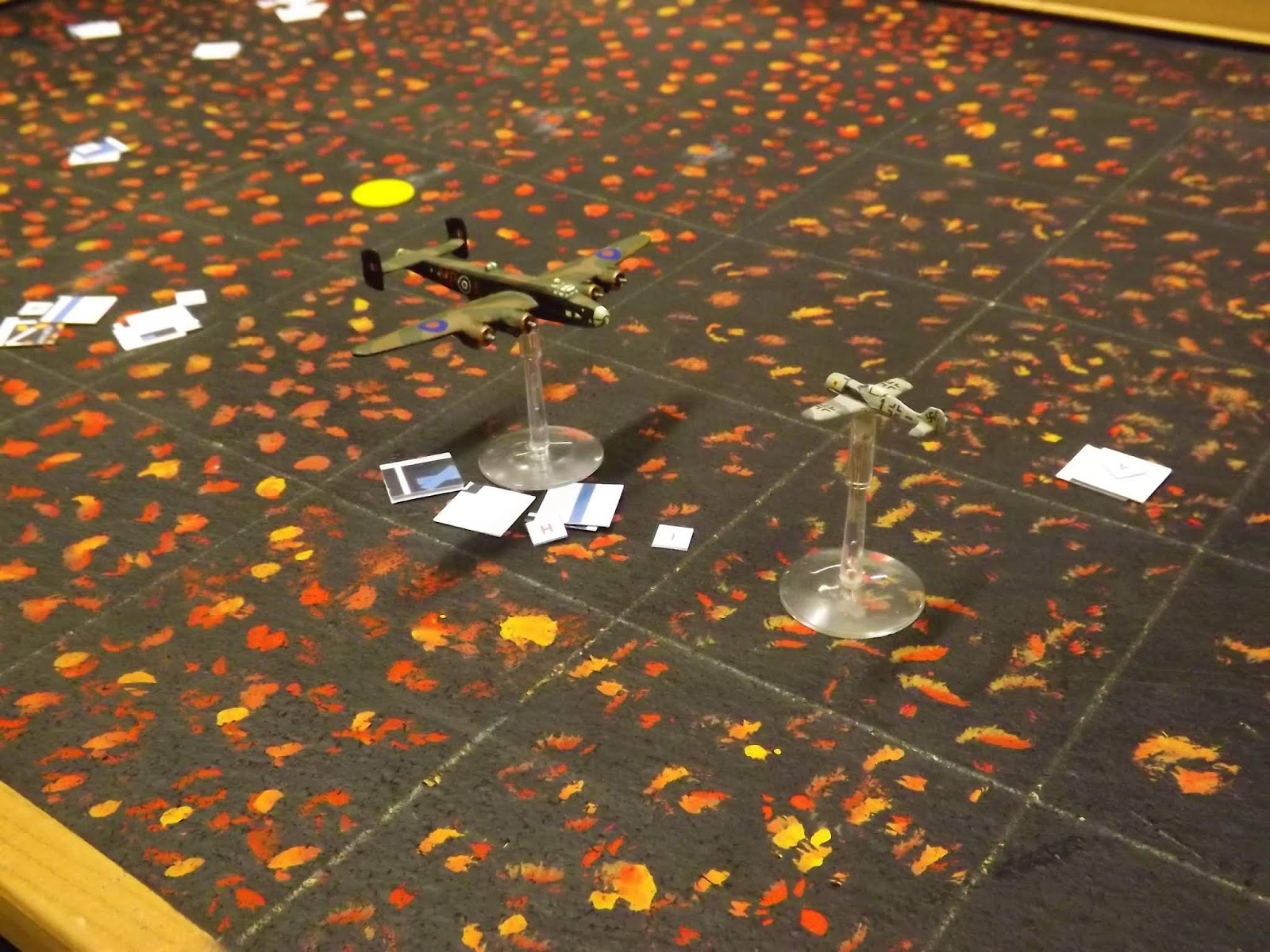
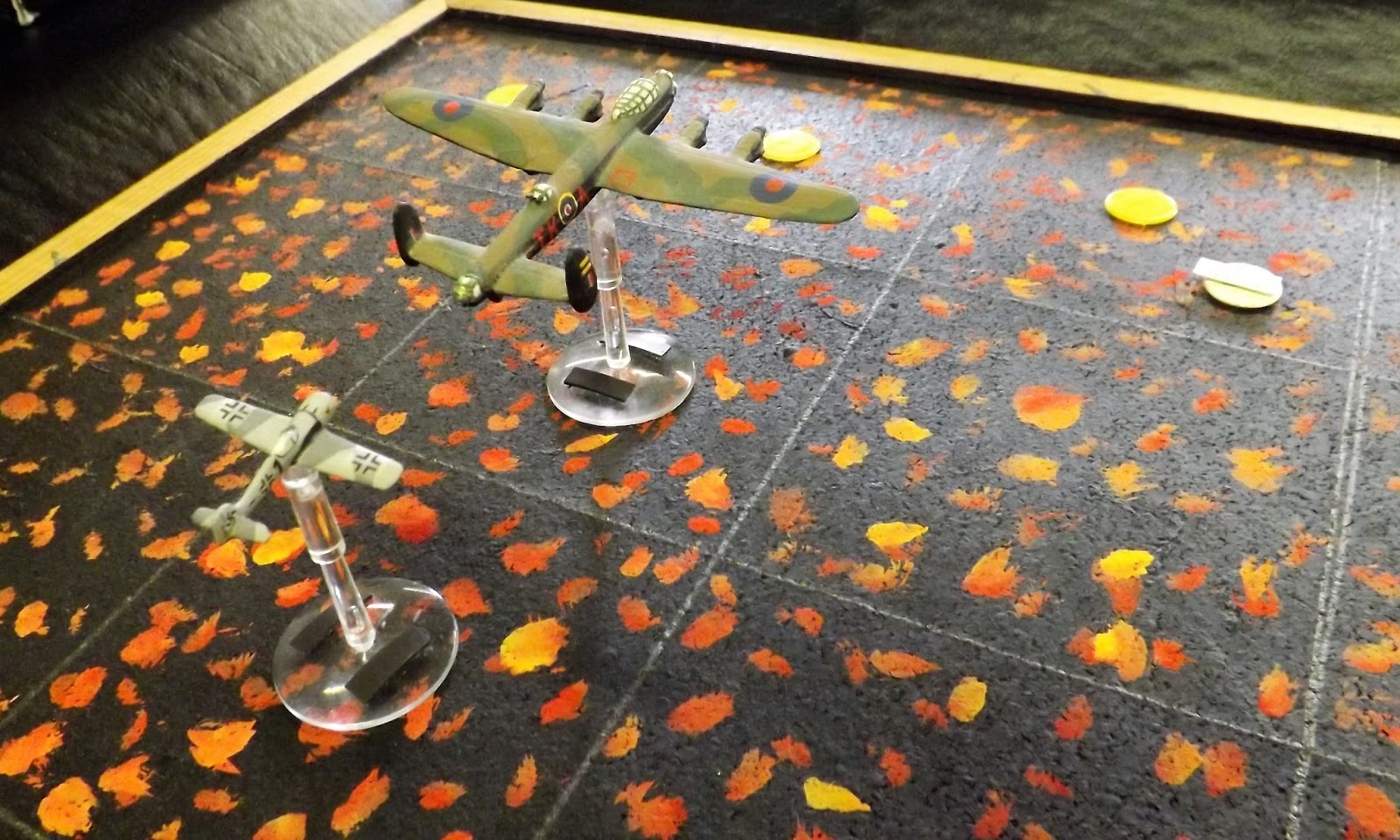
These were an attack by a night-fighter and the bomb run. When these situations occur then play temporarily transfers to the 6 x 8 square gridded board, with one side black and modelling the night sky during a night-fighter interception and the other-side with a similar grid over a flaming city scape modelling the final run into the target culminating with the exclamation 'bombs gone!'
 |
| B-Beer, F-Freddie, P-Popsey and S-Sugar climb out towards the North Sea coast, just as P-Popsey develops engine problems |
When these high intensity actions occur the model planes are moved using playing cards to determine when they can move with bombers moving and firing on black cards at one square forwards or diagonal with one pivot, in the fighter game, simulating the corkscrew evasive manoeuvring and the fighter capable of moving up to two squares and firing on red cards.
With the bomb run the bomber is moving more sedately at one square forwards or diagonally, on the player successfully calling whether the next card drawn will be higher or lower. A failure to guess the next card results in the bomber drifting left or right determined by the colour of the last card drawn. Any plane drifting off the board before reaching the end of it and bombing is forced to go around again starting back in the flak zone.
To add yet more period flavour I insisted that the players in the role of bomb-aimer give their directions for their plane to move, to me their pilot, in RAF parlance, hence 'left left' to move diagonally left, 'steady' for straight ahead and 'right a bit' for diagonally right; very silly but great fun when a player forgets the right term and I as the pilot drift off course because I didn't get the right instruction.
Like wise the fighter game requires the bomber pilot to gain a series of black cards to put enough space between it and the fighter whilst always trying to present a deflection shot to minimise the chances of being hit. All this whilst trying to get off the opposite board end and escaping into the night.
 |
| Alongside the Me110 the Ju88 became the mainstay of the Nachtjagd |
In the first game Ian played with five aircraft consisting of two novice crews (P-Popsey & H-How), two veteran crews (S-Sugar & F-Freddie) with the latter on 29 ops only requiring this mission to complete their first tour and an elite crew (B-Beer) with 47 ops completed, looking to just get through another long night.
In our second game we were joined by Stephen and put together a quick shorter mission to attack U-Boat depots in Bremen with a shorter flight to the target but with a longer return over the North Sea in October with inherent bad weather risks.
 |
| B-Beer has an early unpleasant encounter south west of Bremen on the first leg |
This report will cover the first game with the target map for Derben laid out below showing the target sites as three specific squares on the top left focusing the attack on the oil and refining plants, whilst avoiding the force labour camps and hospital.
One of the most hazardous parts of any bombing mission was the take-off requiring great skill to manoeuvre the sometime 60,000 lb loaded up Lancaster along a night-time runway with 14,000 lbs of bombs on board plus the fuel for the flight.
This was not a time for pilot error and the pilots most likely to make those errors were the novice crews, getting use to their aircraft and night time operations, hence novice aircraft roll two D10 for risks rather than just one for all other crews.
H-How was the first casualty of the night rolling a dreaded '0' and suffering a tyre blow out on take-off was unable to rescue the situation losing control and crashing at the end of the runway with a terrible explosion killing all those aboard.
Meanwhile the other four Lancasters of B Flight climbed off into the night sky over Lincolnshire and headed east towards the coast.
As the coast line rapidly hove into sight suddenly P-Popsey had a problem with the cooling of the port inner engine requiring the flight engineer to attempt to feather the engine without it erupting into flames.
A huge sigh of relief could be heard over Cleethorpes as the planes passed overhead with one merlin engine successfully feathered leaving just three to complete the mission.
 |
| Having survived night fighter encounters, flak ships and navigational errors the flight runs the gauntlet of flak as they approach the bomb run. |
The North Sea crossing went off without any further mishaps, the main factor here being icing up on wings and engines, which was not such a hazard in July.
The next scare came on reaching the enemy coast as B-Beer and F-Freddie both had Monica alarms sound. I as umpire knew that F-Freddie was a false alarm, but had Ian set up the night-fighter attack board and watch him desperately throw the Lancaster around the board until he clocked that the fighter wasn't taking its shots and I declared it a false alarm - great fun.
The alarm on B-Beer however was the real thing, but the cool experienced pilot weaved around the night sky leaving his adversary wondering if there ever had been a bomber to vector in on.
The last two legs to the target were fairly uneventful with spoof raids in the vicinity doing their job and drawing off the night-fighter cover, however that didn't stop three of the aircraft making navigational errors and going off track at least once, and with F-Freddie managing to fly into a searchlight zone and getting coned.
 |
| Searchlights awaited the unwary and off-course Lancaster crew |
The subsequent fuselage hit from the flak that followed seriously wounded the wireless operator and killed the pilot with the flight engineer taking control of the aircraft.
All the aircraft were back on course and unscathed clearing the flak zone in preparation for lining up for the bomb run.
The novices P-Popsey were up first on this, only their sixth, op and just entered the target zone when their bomb-aimer suddenly announced 'bombs gone' and off went their photo flash showing that they had hit the outer residential areas of Derben with nothing else to do but to break off for home.
 |
| First up was the novice crew P-Popsey |
Bomb-aimers as well as having a skill factor are rated as either 'jumpy', 'steady' or 'determined' which causes them to be more or less likely to drop their bombs early, on certain picture cards of varying suits.
With novices off on their way home, the two veteran crews, F-Freddie and S-Sugar lined up with both making pin-point deliveries over the refining and finishing plants just leaving the job to be finished by the experts, B-Beer.
The Lancaster came on steady and was perfectly lined up on the yellow TI's when suddenly the plane was strafed by an unseen free-jagd, single seater night fighter that only managed to cause superficial fuselage damage as it passed, but must have been sufficient to cause their bomb-aimer to drop slightly prematurely, hitting the nearby rail depot to the works, or was that a wrong picture card coming out straight after the attack?
 |
| P-Popsey's, bomb-aimer get a bad case of the jitters and releases far too early |
With all the planes through and over the target B Flight could afford to congratulate themselves on a job fairly well done and focus on setting a course for home.
 |
| Last to arrive over the target were the veteran crew B-Beer who get attacked on the final run in by a Wild-Sau night fighter and the bomb-aimer releases slightly early. |
Perhaps the homeward leg is the worst for keeping crews focused on the job with the tension of the bomb run over.
That might explain the losses of both S-Sugar and P-Popsey over Giessen as night-fighters, no longer conned by the earlier spoof attacks, circled in wait for bombers clearing the target.
The night-fighter was by far away the most effective cause of bomber losses in the night battles over Germany with the majority of kills going to a select group of 'experten'; and try as they might to get into deflection attitudes both aircraft succumbed to multiple engine strikes with just the bomb-aimer from P-Popsey able to bail out and survive to be taken as a prisoner of war.
 |
| With the early drop of P-Popsey, the rest of the flight make a good attack with S-Sugar and F-Freddie bang on the yellow TI's (Target Indicators), whilst B-Beer has hit the local rail yard. |
After the losses of the Giessen leg the only scares on the other return legs were navigational rather than life threatening and structural and the two survivors of B flight were soon across the channel and calling in on the approach to join the circuit in preparation to land.
Lowering 10' of flap and throttling back, the flight engineer on F-Freddie, having brought the Lancaster all the way back from a successful bomb run following the pilot being killed and the wireless operator left severely wounded after being hit by flak, prepared the aircraft on final approach.
As the big bomber descended towards the runway the final checks were being made including that D10 damage die roll; remember what I said, don't throw a '0' especially as we are on the last op of our 30 op tour and leave awaits after a good 'sesh' down the at the Old Bull and Bush.
 |
| With all bombs gone, the throttles are opened up to get clear of the target and on course for home |
Hang on was that a '0' you just rolled, and was that a tyre burst I just heard? - 'look out Skip !!!'
Suddenly F-Freddie took a lurch to the left and careened along on the port wing as the undercarriage collapsed causing sparks as the plane made contact with the concrete runway. The plane slid along for several hundred yards away from the runway and, coming to a halt, caused a collective intake of breath from observers on the tower.
Then, almost within a second of the plane stopping, an enormous yellow ball of flame vomited from the centre of the fuselage as the aircraft exploded into flames lighting up the main runway.
As the realisation sunk in that there were no survivors from F-Freddie, the distant throb of four Merlin engines throttling back on finals announced the arrival of B-Beer over the threshold of runway 270 as the veteran plane gently dropped in on the runway with full flap helping to slow the great aircraft down as without further mishap the only survivor of B flight taxied back to the dispersal pens and a ride for her crew to the debrief.
 |
| A chance for a check on the damage status in preparation for the home leg with still a long way to go |
The game played just as I remembered it with moments of great drama and narrative that moves this up several notches from a simple "Beer & Pretzels" affair.
The second quicker game with a four plane raid to Bremen produced equal drama with one bomber dodging a night-fighter attack and two searchlight conings to complete an in out mission successfully while others fell unluckily to single but deadly flak hits and with one bomber exploding after being hit in the bomb bay by a night-fighter using the deadly up firing guns or "Schrage Musik".
 |
| Suddenly the 'Monica' alarm sounds as S-Sugar attempts to corkscrew out of trouble |
Whilst we all walked away from a very fun game unscathed and ready for a beer or two we all felt the game really captured something of the terrible stress and constant state of alarm flying these missions must have had on the crews, not to mention the near impossibility of bailing out when the big Lancaster started to drop out of the sky, with the best bail out result we achieved being three out of the seven crew and no pilots.
Thanks to Ian and Stephen for joining in what was a really entertaining afternoon's game and with ideas to get more players in on future plays to see if we can put a squadron in the air.