Showing posts with label Zulu. Show all posts

Saturday, 20 November 2021

Zulu - Rorke's Drift Battle in a Box!


Every now and then you get to play a fun wargame that leaves a marked impression, and a game that seemed a bit different from the usual stuff.

This month at the club, Mel and Lee travelled down from their home in Bournemouth to put on their second game at the club since running their great rendition of The Battle of Pelennor Fields using War of the Ring, back in March 2020 just before we and the rest of the world got used to a new normal and our regular gaming meetings got put on hold. If you missed the report on that excellent game, enjoyed by all who took part, just follow the link below.

Devon Wargames Group - The Battle of Pelennor Fields

Remembering the fun we had and the recollection of the effort and attention put into that game I was very interested and looking forward to seeing what they had come up with for our excursion into the Zulu War of 1879 and more precisely the famous Battle of Rorke's Drift, an action we have played previously at club with various rule incarnations, but this time we would be using Lee and Mel's very own rules designed around the set up seen below which forms the prototype for a potential new game in a box, perhaps complete with figures rules and terrain for those of us who love this colonial wars theme. 

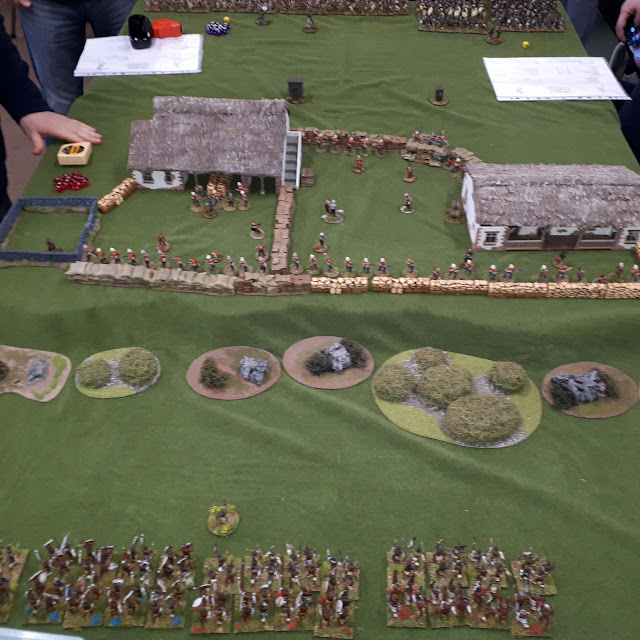
The Rorke's Drift layout complete with prototype buildings lacking roofs at the moment while the game is in testing.

So what's different about this particular rendition of such a famous action, you might be thinking, as indeed I was when I sat down to assume the role of Corporal Allen and his brave section of twelve stout hearted lads ready to do or die for Queen and Country.

Stanley Baker and Michael Caine in Zulu 1964

Well first off the game is designed to very deliberately recreate the film driven images this battle has taken on ever since the release of the iconic film Zulu made in 1964, perhaps one of the best British war films, if not one of the best war films ever made and now a staple of most Xmas or Bank Holiday viewing with a stellar cast of character actors headed up by the late great Sir Stanley Baker as Lieutenant John Chard, Royal Engineers and the up and coming new star back then, Sir Michael Caine in the role of Lieutenant Gonville Bromhead 24th 'South Wales Borderers' Foot.

Given how most modern wargame audiences familiar with the battle would immediately think of the film and all its memorable moments and catch phrases that have become common parlance, certainly among British wargamers gathering around a table for Rorke's Drift; such as the brilliant portrayal of Colour Sergeant Frank Bourne, by another great English character actor, Nigel Green when asked by one of his nervous young privates on sight of the Zulu horde before the ramparts 

'Why us sarge?' 
'Because we're 'ere lad, now face your front and mark your target.'

Perfectly capturing the stiff upper lip, determination in the face of a desperate situation displayed by the defenders that day in 1879 and their courage no doubt bolstered by a reliance on discipline, drill and training epitomised in the words 'face your front and mark your target'.

Zulus are sighted in the hills around the Rorke's Drift post and the bugle sounds calling the men to arms

The second interesting aspect of the game is that all the players involved assumed the role of key characters from the battle and indeed the film, with each of them having their own particular characteristics to influence the fighting in their area of the table and with the soldiers under their direct command as well as having their own unique combat skills and abilities together with the occasional personal mission, such as Corporal Allen using his personal initiative to rush to the aid of the men trapped in the hospital when set on fire later by the Zulus.

Each of our player characters came with their own unique set of stats to facilitate their personal role in the battle and capture still further the filmic nature of our game.

In addition my character Corporal Allen would contribute directly to the combat efficiency of his twelve man section, by the addition of a red (discipline) and blue (combat) dice added to the twelve white dice rolled by his soldiers when shooting or engaged in melee, with a successful score causing him to add to the enemy casualties with his own effective shooting or bayonetting but also making it more likely for his men to cause more casualties by directing their efforts, indicated by a lower score on the white dice needed for their effectiveness at killing the enemy.

Lieutenant Bromhead oversees his reserve section ready to deploy to a threatened sector as needed

Finally the actions of the Zulus and the impetus of their attacks on the defences was all controlled by Lee and Mel as they ran the game, seeing cards drawn to determine British and Zulu special game events each turn, that could cause a positive or negative impact to either side that turn and generate the arrival of Zulu regiments from different board edges throughout the game.

The results of combat would see the effects on the Zulus referred back to Lee as he could check to see what each unit would do in response to being shot at or casualties received, whilst we as the defenders could only look on and wait and see what the reaction to our efforts would be and prepare our response to the Zulu reaction accordingly.


The great thing about the card sequencing of play is that it enables aspects in the film to take effect, nicely modelling the seemingly random attacks by relatively small groups of Zulus early on in the battle as the defences were tested for weak spots, finally ratcheting up following the historical eclipse of the sun that confirmed to the Zulus that victory was theirs for the taking and causing multiple attacks to suddenly generate from multiple directions all at once.

The first attacks tested the defences for weak points but were limited and allowed a focussed response

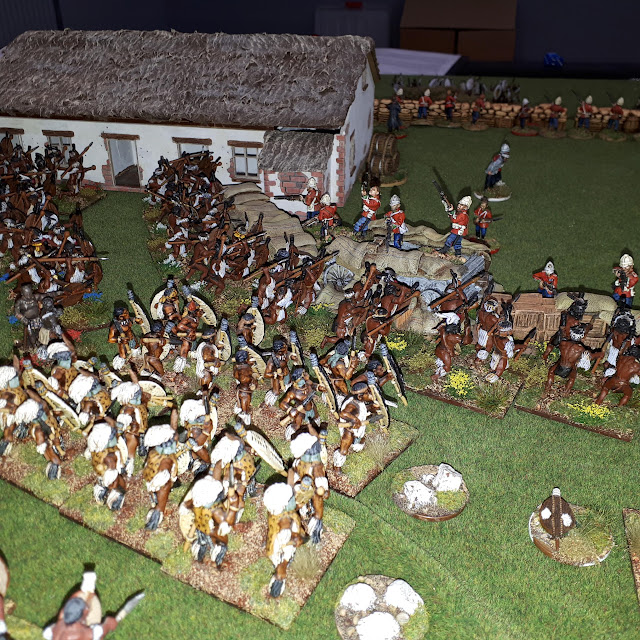
The attacks soon built up and stretched the British line to hold them

As players focussed on managing the various sectors of our respective perimeter the tension built and calls would go out for support from other less hard pressed sectors or for an encouraging shout from a charismatic leader to help bolster the discipline and therefore capability of a hard pressed unit.

Another enemy group thrown back with heavy losses but look at the the thinned out defenders before them

Groups of Zulus could range from two, four or six bases each with eight figures per base and with the game based on a what you see is what you've got, one figure to one man ratio, the small thin line of redcoats could suddenly look rather hard pressed, raising the tension another notch.

Firing on newly appearing Zulu warbands could provoke an immediate charge to a standing chant by the warriors clashing their shields in imitation of the distant train so well imitated in the film.

Knowing when to fire and hold the position or to fall back as supporting units fired on large groups clambering over the mealie bags became a required skill, made more tense when the  'low on ammunition' card came out prompting Commissary Dalton to have to make his way to the affected sector dragging the necessary ammunition boxes to keep the line firing.

Nine men down from the section of twelve and things are looking a bit concerning!

Of course success in driving off the attacks was one thing but if our player characters were to imitate their historical ones we needed some heroics to be rewarded with the bucket load of Victoria Crosses the actual action merited and so managing to disperse a Zulu attack was rewarded with a VC and all the players were able to encourage their commands with additional medals as 'the general public don't like to read about too many defeats in their morning papers - bad for morale' card delivered said encouragement and we all rolled for additional gongs for the men - great stuff.

Allen's sector holds firm but he can do little to help those men caught in the hospital as the fire takes hold

What we as players didn't know, rather like the real life defenders and as depicted so artfully in the film, was precisely when this battle would be all over - you remember the scene as the chanting and singing starts from the Zulus on the cliffs above, leaving our heroes thinking their time was up, only to be told by the Afrikaner Adendorff that they're saluting you! Its all over!

Each game will have its own predetermined ending and so ours reached its ultimate climax as multiple large Zulu attacks crashed into the perimeter from all sides with Colour Sergeant Bourne up on the parapet delivering well timed bayonet thrusts and Corporal Allen forced to abandon his barricade to help the defenders on the other side of the perimeter forced back in the last attack and now down to a handful of defenders.

Allen successfully delivered a telling volley that stopped the Induna led six base Zulu attack right on the perimeter to then have to turn his men about to deliver yet another telling volley that drove out the Zulus that had just charged in on the section of defences he had just pulled back from.

Then just as it looked like the outer perimeter would have to be abandoned with the last escapees evacuating the burning hospital, it was over and the station was held heralding a Zulu withdrawal and for us a well earned pint. 

What a battle and with ten VCs awarded for bravery over and above in the face of the enemy we could take time to tend the wounded and prepare for all those after dinner speeches that would be required once back home. 

Colour Sergeant Bourne up on the parapet winning his VC in the thick of the action as the last big attack was held

Mel and Lee are to be congratulated on designing such an filmic and fun game capturing all the narrative that this iconic battle deserves and frankly I'm surprised no one has come up with a similar idea previously.

Having played several of these Rorke's Drift battles with other systems this was by far the best and most immersive of them and that's saying something, as we have had some cracking games at the club and reported about them here on the blog. You can get a feel for the game in a short clip of it below as the action started to intensify as the hospital caught fire.


The rules themselves would also likely lend themselves to a big battle version for doing the larger field battles of the campaign and the Zulu activation and response method pioneered by systems such as Pony Wars and Peter Gilder's Sudan rules really work well for these kind of native irregular armies and I know, talking to Lee, that he sees the rules very much as a tool kit designed to have some of the rules used for certain game types and not for others depending on what is needed for that particular game.

I wish Mel and Lee well with developing this idea further as the work they have done to get the game to this stage is impressive and I would certainly be interested in it as the kind of game you could put on quite easily with a group of friends, with no two games ever likely to play out the same and with loads of narrative to chat and laugh over with a beer when the shooting is done. 

Sunday, 9 February 2020

KwaJim “Jim’s Place” Rorke’s Drift, January 22-23, 1879


“You will be in charge, although of course nothing will happen.”

- Maj. Spalding to Lt. Chard


In a smoky cinema in Gloucester, I saw the film Zulu and was bitten. Back then, in the 60’s, the selection of model figures was lamentably small, but from a distance, an Airfix WW1 German Infantryman with his pickle halbe painted white, and his tunic painted red just about passed as a redcoat – but Zulus?


Later, I came across Edward Suren’s diorama of Rorke’s Drift in the National Army Museum (where’s that gone, now?) and my first ‘proper’ toy soldiers came from his shop in Lower Sloane Street and they were of course, a Redcoat and a Zulu. 


When Nathan said he was putting on the Rorke’s Drift scenario at the club, I jumped at the chance. He has an enviable Anglo Zulu War collection and it was a real pleasure to be able to play with it.


In the scenario, the British have thirty-two regular infantrymen made up of six companies of eight figures. In addition, they have Surgeon Reynolds and his hospital corps, who can patch up the wounded and send them back to the barricades, a number of non-combatants, who can carry the wounded to the hospital corps, and of course, character figures including among others, Colour Sergeant Bourne, Sergeant Williams and Lieutenants Chard and Bromhead, not forgetting Pip, the dog.


The Zulu forces consisted of four amabutho (regiments), the iNdluyengwe, uDloko, uThulwana and iNdlondo, made up of between three and five izigaba (a division or group of related companies) making a total of – well, Fousands of em'...


Rorke’s Drift comprised of two compounds. To the East, the Storehouse compound with a small
cattle kraal, and to the West, the Hospital compound. To the North of the compounds ran a ledge
from West to East surmounted by a barricade made up of mealie bags, biscuit boxes and wagons. To
the south, the two buildings were connected by a similar barricade. The two compounds were
divided by a barricade of biscuit boxes running North to South. 


The British deployed two companies along the northern barricade and one company manning the
southern barricade. One company occupied the hospital and the two remaining companies were
tasked with building a redoubt in the Storehouse compound leaving the storehouse lightly defended
as there were no openings to the south, and therefore inaccessible from Zulu attack from that
direction – or that was the thinking.


The hospital posed a problem; although it had several rooms with openings to the south, there was only one internal door. If the regulars were attacked, there would be no means of escape and they would be lost. However, if it wasn’t occupied, there would be nothing to stop the Zulus coming round the southwest corner of the compound unmolested.


Lieutenant Chard took command of the Hospital compound while Lieutenant Bromhead took care of the Storehouse compound. It all looked rather sparsely held.


The first Zulus appeared to the south of the mission. They were warriors of the iNdluyengwe ibutho
with the unenviable task of testing the fire power of the defenders. They bounded forward, crossing
the ground at speed, but were met with a hail of lead erupting from the windows and loopholes of
the hospital and the barricade. Two izigaba were blown away and the third isigaba was stopped in its
tracks and went prone. The Martini-Henry was doing its job.


 Just then a cry went up.
“’Ere they come, black as hell and thick as grass!”


Zulu forces were seen massing both to the north and the south. The Zulu onslaught was about to
begin in earnest. Zulu warriors advanced on the northwest corner of the compound but their
progress was slowed by the terrain and the ledge which gave the defenders time to deliver several
telling volleys into their ranks, forcing them to withdraw or go prone.


The Zulus attacking the southern defences were not hindered by the terrain but nevertheless, their charge was stopped midway and they too were forced to go prone. 


However, two izigaba reached the walls of the storehouse and with a blatant disregard of the rules in the scenario stating ‘the roofs of the buildings are not used. They may not be deployed upon or moved onto’ they clambered onto the storehouse roof. No game this, then – this is for real. One isigaba started to make holes in the roof, while the other attempted to set fire to it. Quite how they proposed to do this was a bit of a mystery. Rub two assegies together?


A third isigaba advanced around the southeast corner of the storehouse to have its way blocked by the cattle kraal. They were eventually allowed to pass, despite some of the herd recognising their relatives on the shields of the warriors.


“Why me, Serg?”
“’Coz your ‘ ere, son.”


A cry rang out from the northern barricade. The defenders had suffered their first casualty. Private
Williams, (or was it Jones,) had been hit by a Zulu sharpshooter who was skulking in the rocks
overlooking the northern compound. There was some scoffing at the name ‘sharpshooters’ and a
suggestion that ‘bluntshooters’ would be more appropriate. However, as they accounted for a
defender every time they fired, this assessment of their ability had to be called into question.


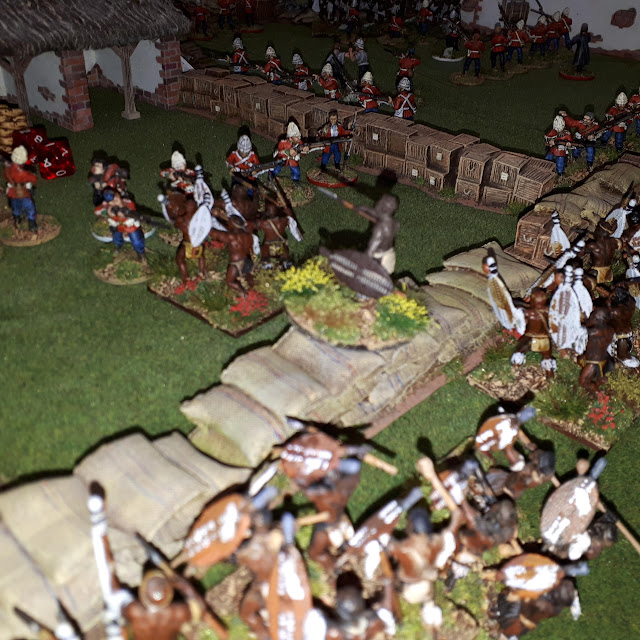
Things had also taken a turn for the worse on the southern perimeter. The Zulus had braved the fire
and had closed to contact. The troops manning the barricade, despite the presence of Colour
Sergeant Bourne, were forced to fall back, losing several men. The hospital saw bitter hand to hand
fighting but as the men had no means of escape, they were all slaughtered, their bellies slit open and
the walls covered in their blood. Only two men manged to escape the carnage. No Victoria Cross for
Gloucester born Private Hook this time round. One unknown Private, probably another Jones or a
Williams – or a Steve, tenaciously defended a broom cupboard.


He beat off several ferocious attacks but inevitably his luck ran out and he succumbed to one last
desperate assegai lunge. Meanwhile the isigaba on the roof of the storehouse had given up lighting a
fire and had joined the other isigaba hacking holes in the roof. They quickly gained entry. In the
compound below, Bromhead received a report from the KwaZulu Natal Environment Agency
informing him he had ‘Zulus in the loft.’ He was forced to detail some of the men who were building
the redoubt to go and sort the problem out.


In the northwest corner the Zulus, by sheer weight of numbers had reached the barricade and had
driven the defenders back. Sergeant Wilson was last seen standing on a wagon surrounded by Zulus.
With Zulus now in the Hospital compound, Surgeon Reynolds and his hospital corps were forced to
move towards the relative safety of the Storehouse compound. He and his team continued to do
sterling work patching up the wounded but things were starting to look desperate. With both the
southern and northern barricades breached, Chard formed a firing line with his back to the northern
barricade facing what seemed like thousands of charging Zulus.


It was then he received the report from Bromhead that the sharpshooters had been neutralised. That was the least of his problems. Some well-directed volleys kept the Zulus at bay long enough to cover the retreat of the men from the northwest barricade. However, the Zulus who had been taking cover behind the southern barricade had grown in numbers and hurled themselves across the intervening space.


“Steady, lads, steady. Fire at will!”


Whether it was because Colour Sergeant Bourne had failed to give the command to aim or there was
no one in the Zulu ranks called Will is not known, but not a single shot hit its target and the Zulus
came on unchecked. Fortunately, the firing line was saved by some well-directed fire from the
biscuit box barricade and the Zulus were once again forced to ground, giving the remaining
defenders in the Hospital enclosure time to cross into the Storeroom enclosure and form a double
line, back to back. There being no room for Surgeon Reynolds and his hospital corps he was turfed
over the barricade onto the ledge to take his chances. Room was, however, found for Pip, the dog.


The Zulus in the loft proved to be an insurmountable problem and despite a prolonged hand to hand
fight and the roof space catching fire, the Zulus were victorious and poured down into the
Storehouse compound together with the Zulus from the cattle kraal – to be confronted by a redoubt
bristling with bayonets and spewing out lead. Despite throwing themselves against this bulwark,
they were unable to dislodge the defenders.


Who won? Well, it didn’t really matter as it had been such a terrific game. The British lost almost half
their force but managed in the end to establish a strong defensive position. There were still ‘Fousands’ of Zulus left and given time they might well have worn down the defences but at what
cost? A meat grinding type of game is not that satisfying to play so we finished it there. It also spared
us from bursting in to a spontaneous rendition of ‘Men of Harlech.’


The rules we played were Chris Pagano’s ‘THE BOYS From Isandhlwana’ and are really excellent,
particularly the way morale is dealt with. The Zulus are only subject to morale when they receive
fire, so it is hard for them to get into contact. Once in melee, however, they take no morale tests, so
their sheer numbers grind the defenders down. Any British within two inches of a Zulu is in melee and therefore cannot fire, which means you really have to think at least one move ahead in order not to get sucked into a hand to hand fight which you are likely to lose eventually.

In the end though, you run out of space and you have to face the music. None of us had played these rules before but they were quick to pick up and the game bowled along with minimum explanation required from Nathan, whose umpiring decisions did much to enhance the game. Imagine what we would have missed if the Zulus had followed the rules and stayed off the roofs. No ‘Zulus in the loft, Sir.’

My thanks to Mike and JJ for throwing themselves so selflessly at the barricades (it is for real, right?)
and to my fellow defender Ian, who kept the stores in order, got rid of the sharpshooters and saved
our bacon by getting the redoubt built. But most of all, a huge thank you to Nathan for giving us the
opportunity to replay ‘Zulu’ with his beautiful Anglo Zulu War collection.

Saturday, 2 November 2019

Battle of Khambula 1879 - Sharp Practice II


The newly arrived Zulu Army, commanded by Chief Mnyamana Buthelezei, moved on towards Khambula in battle formation; the mass of warriors forming the ‘chest’ with other columns as the left and right ‘horns’, ready to envelope the British, encamped ready for battle the next day.


This time, the British, while in low morale after Isandlwana and the defeat of Buller’s attack on Hlobane, were prepared and in compact formation behind fortifications, unlike Pulleine’s 24th Foot at the Battle of Isandlwana.


A British patrol, out early in the morning, brought in a Zulu defector with information that the camp was to be attacked at midday. The patrol reported that the Zulu Army could be seen approaching. The main fortification of the camp was the wagon lager, the wagons parked end to end in a square, with additional fortification from heaps of turf, mealie bags and an entrenchment.


The cattle were held in a square of wagons on a raised area of the plateau. In the centre of the camp area stood the earthwork redoubt built on a knoll.


As soon as the Zulu approach was reported, the troops assembled at their positions, 1,200 men of the 1st/13th Light Infantry and the 90th Regiment, with 800 other irregular troops. Ammunition reserves were established along the rear of the lines.


Wood’s artillery comprised four 7-pounder guns, two mule borne guns and several rocket troughs. The mule guns took post in the redoubt, while the 7-pounders stood in the open ground between the
two main fortifications.


The Zulu formation paused for a time, while final arrangements for the attack were made. It may be that the Zulu generals wished to avoid a direct assault on the British camp; Cetshwayo’s instructions being not to repeat the mistake of Rorke’s Drift, but to threaten the Natal border and try to lure Wood’s force into the open. However, the Zulu warriors were in no mood for caution. The Zulu Army began to move towards the British with increasing speed, the horns spreading out to the left and right flanks, the chest heading straight for the camp. The battle began at around 1.30pm.


The left horn disappeared from view, as it moved into the valley to the South, where it was held up by marshy ground. The right horn circled round to the North and came in towards the camp. Wood dispatched Buller with his mounted men to provoke the right horn into making a premature attack, before the other sections of the Zulu Army were in place. Buller’s move had the effect intended, the mass of the right horn rushing towards the British fortifications.


Buller’s troops rode back into the camp, several men having considerable difficulty getting away from the fast-moving mass of Zulu warriors.


This is where our battle transfers to the table top Sharp Practice game, the Zulu army consisted of 20 units of 12 on left and 20 units of 12 on right each with 6 leaders both Black 1 to 6, the British army as per the OOB were within the Laager, the Kraal and the Redoubt, the redoubt and Laager were classed as high and wide obstacles for the purpose of the game...


The Zulus as the cards were drawn out were told they had to randomise the location of point of arrival, 1 to 2 being first 2ft of the 6ft length and 3 to 6 being 4ft length and 7 to 8 being 2ft of the other 6ft length of table, this being done on both flanks, therefore not allowing Zulus to mass straight away and having to manoeuvre to co-ordinate if/when they could...


The Zulus managed to get most of their troops on the table within the first couple of turns with only one group each side not coming on due top card pull or due to space in area where they had to arrive, masses of troops causing tail backs etc.


The Brits were able to throw plenty of fire out at the oncoming Zulus, using 'Sharps Practice' and the double fire of breech loading weapons to their advantage, causing devastating wounds and shock amongst the Zulu hordes, twice the cannons ripped into the ranks of Zulus causing swathes of men to drop and cause massed shock, a couple of flank shots causing double shock.

The Zulus charging at every opportunity forced the Natals back and making the Light Horse make hasty evades, saving their bacon more than once...

Multiple Zulu units charging and getting up against the redoubt and laager were being thrown back with lots of casualties and shock on the Zulus, and a couple here and there on the British, Zulu leaders becoming more cautious and deliberate after these failed attacks, the redoubt holding fast against multiple attacks, the Kraal not fairing as well, with the Natal, Light horse dying or pulling out leaving the British to face the Zulus alone, outnumbered and fighting back to back they would finally succumb to the numbers and ferocious attacks...


All the while the artillery firing into the Zulus massing on the right flank, causing devastating losses amongst the Zulu, the Light horse were trying to assist there brothers in the redoubt, shooting into the Zulu flanks and annoying the attacks...


The Zulu breaking the British in the Krall, swept into the flank/rear of the guns and made the gunners disperse to the redoubt and Laager, at this the remainder of the Natal, and Light Horse beat a hasty retreat to the Laager...


Back at the Laager the Zulus were starting to swarm, and were sending in co-ordinated attacks, and losing men at high rate of fire and fights were desperate at the barricades, however one assault managed to push the British back and force them to face there enemy back to back.

With the men holding the other side of the defences and with casualties mounting, things were getting desperate. With the Zulu massing, at this point the British commander managed to form a decent firing line, with the Natal and Light Horse joining the beleaguered infantry, and if the Zulus ventured over the top of the barricade they would have been ripped apart... 

The Zulu commanders taking the day as a day well fought decided that with the time as it was, discretion was the better part of valour and decided to call a halt there... casualties were high on both sides, but with a few more turns the Zulu may have won the day; however with the Zulu right flank having taken loads of casualties and forced withdrawals and with its morale waning, it was really left to the Zulu left which was still a formidable fighting force and may have carried the day... 

Maybe on another day... really don't fancy facing the Zulu with no defences in play, could get a bit messy for the Brits?

Thanks to all that played and gave there all, don't know about them but I was knackered at the end of the game...