Labels

Sunday, 19 September 2021

Clotted Lard 2021 - We're Back!

After all the disappointment of not being able to stage Clotted Lard in 2020, it was great to be back up and running this weekend for Clotted Lard 2021.

We had an excellent turn out of club members and fellow Lard enthusiasts from around the country for our celebration of all things Lard and a display of ten games using the rule sets Sharp Practice, Chain of Command, I Aint Been Shot Mum, Bag the Hun, Dux Britanniarum and Kiss Me Hardy, with conflict on sea, air and land, ranging across the ages from Homeric Greece, to post WWII.


With the venue arranged on Friday night and early Saturday morning everything was ready to welcome our guests and club members, and the day's games were quickly up and running from 09.30 with a break for lunch at 12.30 before an afternoon of another round of games, prior to the usual gathering for pre-dinner drinks, banter and a well earned curry.

Clotted Lard 2021

As with previous shows, I spent part of the day circulating with the camera to capture the different games on show together with a little video clip to try and show what the atmosphere is like in the rooms when everyone is happily playing, before I had to get ready to run my own game of Kiss me Hardy in the afternoon session.


Happy wargamers celebrating our hobby in support of charity, doing what we enjoy most, chatting and wargaming with great rules.

So in no particular order I present the games from Clotted Lard 2021, and would like to thank everyone involved in this year's Clotted Lard for helping to get the show back on the road.

'Badges? We don't need no Stinking Badges' Sharp Practice II, Filibusters in 1850's Mexico (28mm) - Colin Murray


Colin has a strong track record of turning out really interesting themes for his games, together with really lovely terrain and figures that capture the look of the era he is representing whether it is his 16th century Eight Years War, Dutch-Spanish collection or his 19th century Afghan War collection and this years game was up there with his best, taking the players to 1850's Mexico, for his Sharp Practice 'Filibusters' game.


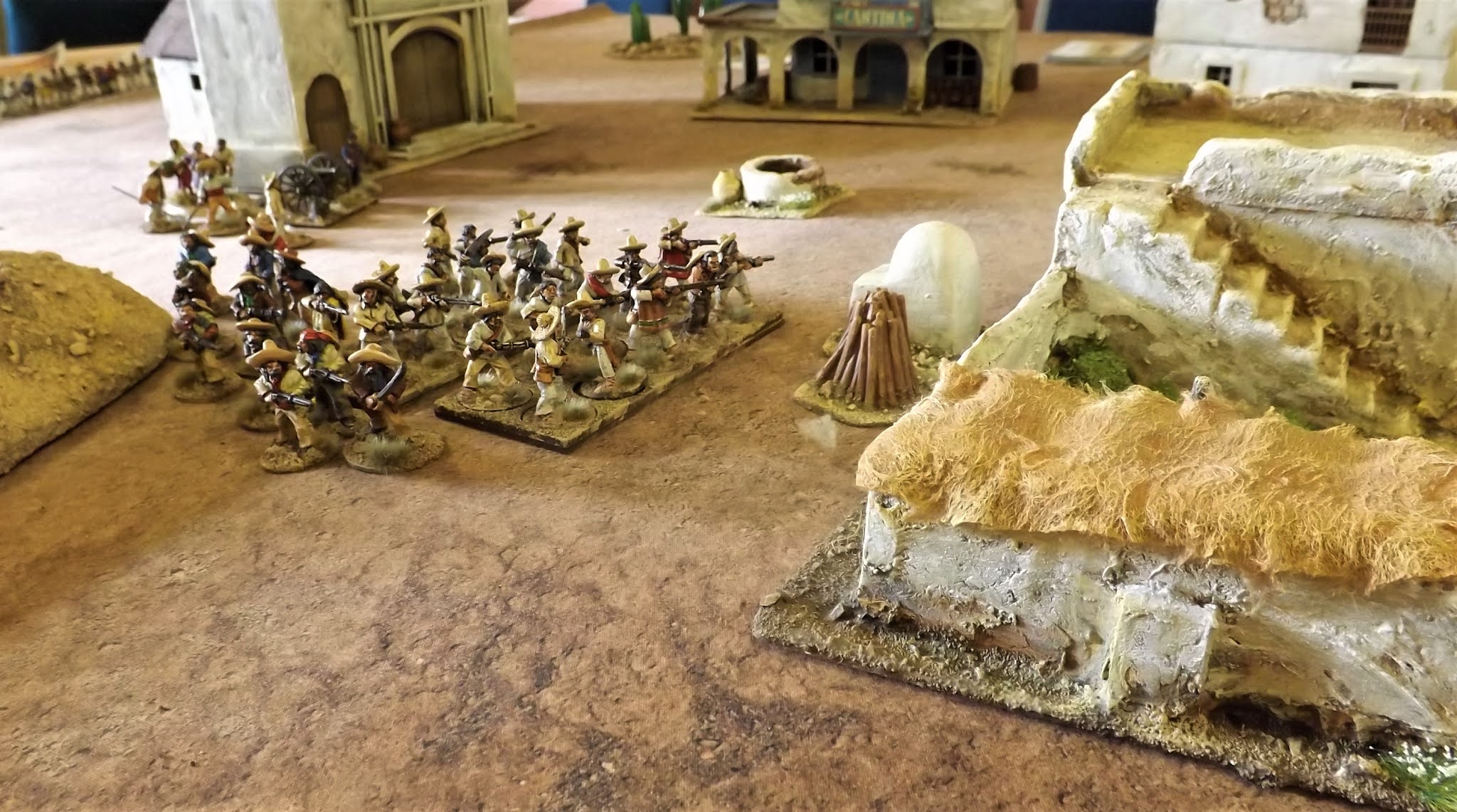


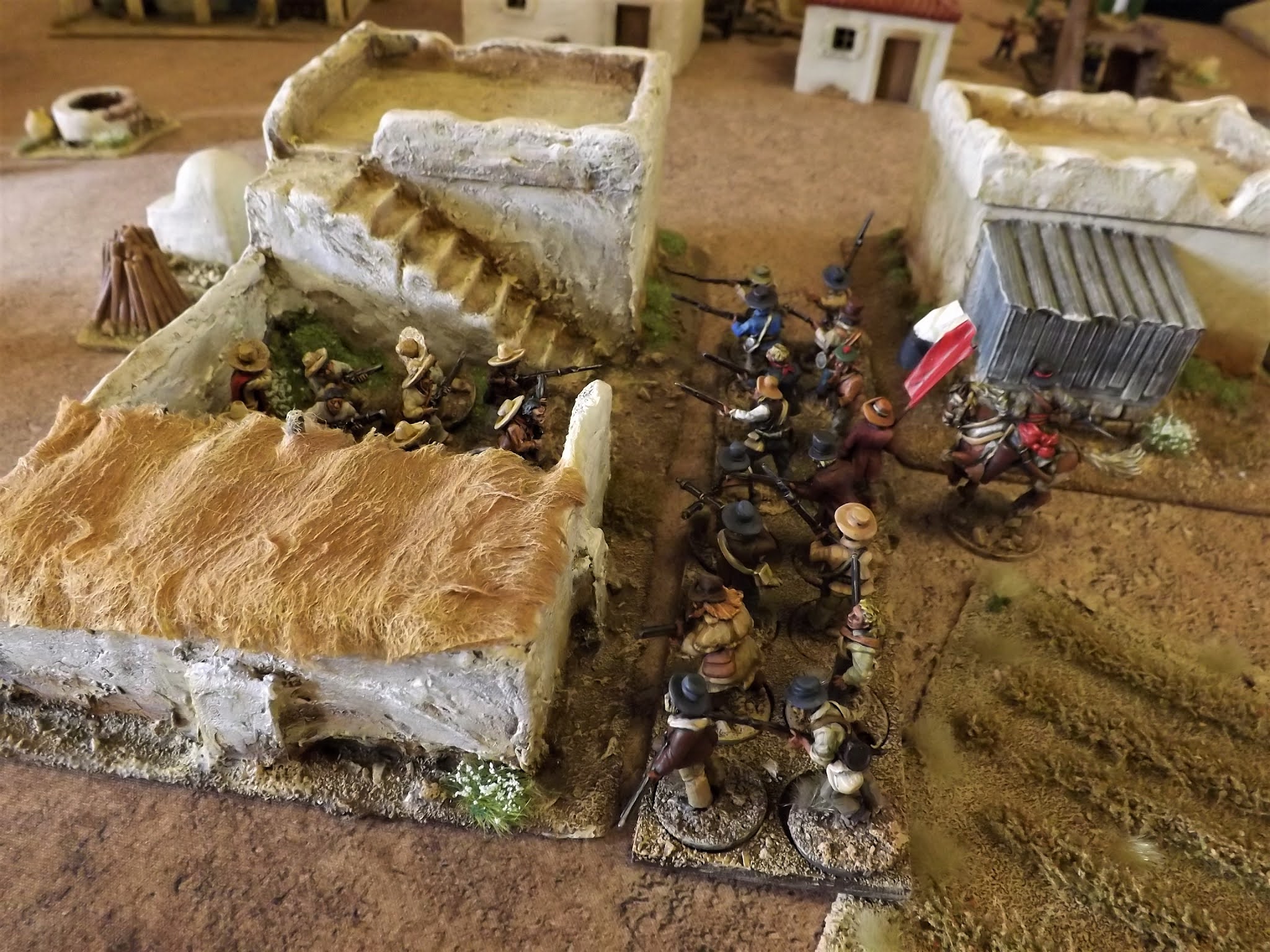


Heroic Daring Do during the Trojan Wars, 'Sacker of Cities' a variation of Dux Britanniarum (28mm) - Chas Carter


As with Colin, the club can always rely on Chas to come up with an interesting theme for his games as illustrated here with his Homeric collection of figures and terrain designed around a variation of Dux Britanniarum that allows for the intricacies of the age of heroic warfare with Hector, Paris, Ajax and Achilles gracing the table, issuing challenges and trying to avoid the odd ankle shot.


'Arrows & Tomahawks' Bag the Hun, RAF vs Regia Aeronautica, WWII Western Desert - Andy Crow


Bag the Hun is a popular set of air-warfare rules and, having a large collection of Battle of Britain British and German types in 1:300th scale and with our own local Exeter based Spitfire in the air this week doing barrel rolls over Exmouth on Battle of Britain day, it was great to see Andy Crow's nicely turned out Western Desert collection of fighters wheeling over a suitably dressed table, as the players tried to devise ways of getting on each others elusive 'six', and with the Italians flying 'Vics' against the latest RAF tactic of 'finger fours'.


'BATT Force' Chain of Command, SAS & Gendarmerie against the Adoo, Mirbat 1972 (28mm) - Jason Ralls & Nathan Goodyear


Jason and Nathan came up with a great theme for their Chain of Command game recreating the dramatic battle at Mirbat in 1972 during which nine SAS soldiers alongside fifty-five Balochi and local Gendarmerie fighters held off an attack by two to three-hundred Adoo guerrilla fighters, during which British-Fijian Sergeant Talalasi Labalaba was mentioned in dispatches for continuing to fire the single 25-pounder gun single-handed at one stage, after being seriously wounded and later shot dead in the neck, prompting calls for and a later campaign to see his bravery recognised posthumously with the Victoria Cross.


'The Leeward Line', Kiss Me Hardy, Collingwood's column at Trafalgar 1805 (1:700th) - JJ


My own efforts this year and last, during the enforced lockdown painting marathon, has focussed on all things age-of-sail naval, with a large collection of Napoleonic 1:700th ships from Warlord Games built to facilitate a future playing of Trafalgar and with a small part of the collection out on the table using Kiss me Hardy and the attack by the leading elements of Vice Admiral Cuthbert Collingwood's leeward column at the battle.

It was great fun testing this scale of model for Kiss Me Hardy.

My set-up for our game, with Collingwood's HMS Royal Sovereign (16) leading the charge against the Combined Fleet squadron led by Spanish Admiral Alava in the Santisima Trinidad (17)


'Somewhere in the Ardennes' Chain of Command WWII Battle of the Bulge (28mm) - Jeff Davies & Geoff Bond


There is something really compelling and very attractive about a well turned out snowy landscape as a backdrop for a battle and Jeff Davies and Geoff Bond produced this really stunning example for their Chain of Command Bulge set-too with German infantry supported by a single Panzer IV having a hard time in the snow against well dug in American defenders and their M8 armoured car.


'Emergency' Chain of Command, Royal Marines vs Communist Terrorists, Malaya 1950 (28mm) Stephen Luscombe


I think one of the best things about Lardy games is that I am always amazed at the variety of themes their rule sets generate and it was really nice to see this rendition of Malaya 1951 by Stephen Luscombe as an example of that variety, again using Chain of Command, and showing that the idea of using dog handlers to sniff out ambushes and improvised explosive devices is nothing new.

I reckon Stephen will be happy if he never has to create another model palm/rubber tree group ever again!


'Fighting at Stonne', I Aint Been Shot Mum, France 1940 (15mm) - Phil Turner & Jenny Owens


Phil and Jenny have supported Clotted Lard right from the get-go and have graced the show with some lovely games in that time with Jenny's ability to create a glorious table around their chosen theme and this year it was around a favourite set of rules for me, I Aint Been Shot Mum, that I played to destruction a few years ago with my Normandy collection of 15mm figures but here recreating the famous battle for Stonne in the May of 1940.

The fighting in this table-top engagement focussed around the main street as French recon elements clashed with the German armoured spearhead before French armour and each sides infantry joined the fray amid the maze of houses, back yards and streets.


'Up among the Pandies' Sharp Practice II, Indian Mutiny (28mm) - Simon Walker


The Indian Mutiny is a popular theme for Sharp Practice and one we have had feature in our own club games, and seeing Simon Walker's rendition helps to explain why, with a glorious mix of uniformed regulars and native irregulars amid exotic Indian buildings and suitably attired British ladies and their servants attempting to get away amid the exchanges of musketry.


'A Matter of Some Urgency' Sharp Practice II, American War of Independence (28mm) - Jim Ibbotson


I am in the process of building my own AWI Mohawk Valley collection of 28mm figures for Sharp Practice and so it was a pleasure to see the modelling talent of  Jim Ibbotson and his own AWI rendition of the Queen's Rangers plus Indians taking on a collection of American militiamen on a lovely table that has given me plenty of ideas for my own games.


As always, everyone had a great day's wargaming and much fun was had by all.

Once again thanks to all involved and here's looking forward to next year.

JJ

Sunday, 12 September 2021

Fort William Henry Massacre 1757 - Black Powder

The Last of the Mohicans 1992 - Wes Studi as 'Magua'

Mr Steve M dug out his 28mm collection of French Indian War troops to entertain us with a rendition of the Black Powder scenario loosely recreating the events of the Fort Henry massacre of 1757 and vividly portrayed in the 1992 film, The Last of the Mohicans; as Colonel Edmund Munroe attempted to evacuate his sickly force from the fort under the terms of a negotiated withdrawal with French General Montcalm only to see the British column attacked by French allied Indians along their withdrawal route.

The table below is set up for the start of our game with several British infantry groups ready to attempt to reach the other table end and sanctuary or with the canoe representing a possible escape route over the river for one of our nine groups.

The French unit of regular troops represent another alternative for our beleaguered redcoats, as possible guarantors of safety should they be appealed to on route. 


Below, can be seen our nine British groups loosely arranged in slow moving back to back platoon squares, with their activation dice arranged and each group of three having two baggage/distraction points available to be distributed about the table on our route of march, hopefully to distract groups of attacking Indians in one, two or three turns of baggage looting instead of redcoat scalping.

In the end, Lawrence, Paul and myself opted as British commanders to spread the distractions markers out equally across the table to give all our units as much cover as possible, however as play would demonstrate it may have been more advantageous to have given Lawrence the weight of that cover as his units were closer to the tree line on the side opposite the river which would be a constant source of Indian attacks throughout our game.


Simon took command of the Indians, adorned himself with war-paint, and assumed the role of Magua as the dice were rolled for each group of redcoats to make their perilous march to the opposite end of the table.


At first the game was seemingly looking rather straightforward as the activation on a score of eight or less with 2d6 seemed very gettable and the rapid movement rates in Black Powder of twelve inches had our huddles of soldiers advancing up the table.


Not only that but the distraction markers were starting to take effect as Indians changed direction in favour of a bit of easy looting rather than tangling with the soldiers and with a few musket exchanges thrown in for good measure the first Indian groups were soon recoiling from where they had come.


However the learning curve was relatively short lived as both sides started to appreciate the benefits of massing musketry on the same target, with the Indians taking advantage of the nearest cover to start to administer hits and disruptions on the British clusters, with three hits not saved causing the groups to become shaken and eligible for an Indian charge to contact.


Thus the progress of the British started to slow as discretion meant that faster moving groups had to wait for stragglers to catch up to combine their fire, and the occasional halt needed to remove hits and disruptions, with ever more groups of Indians appearing from practically all corners of the table, making retreats and halts ever more perilous.


My particular column seemed to have the easier route, marching along the bank of the river which gave respite from attack from at least one direction, so much so that my two lead groups rapidly made it to the canoe allowing one of them to use it to make its escape, the only group as it turned out that did so.

This minor victory was two edged in that my firepower was reduced by a third and when the groups became separated as was inevitable they were easier targets to be attacked piecemeal, despite valiant efforts by Paul's centre column to lend a hand.


On the tree line flank the battle was very much different as Lawrence soon had his hands full with multiple groups of Indians pouring on the hurt from the cover of the trees and despite some excellent return fire from his redcoats, driving off a couple of groups in shaken disorder, Simon had the Magua touch and constantly managed to save two and three hits on multiple occasions that brought the British advance to a halt as movement individually and without support of the others became very risky.


As the Indian resistance to the British advance grew, the battle on the river bank and the centre grew in intensity as the redcoats attempted to force a passage with Paul managing to cause a couple of groups to disperse after failing morale checks.


On the river bank, my lead group managed to get within three or four inches of the table edge but multiple hits and disruptions stopped the group for getting off the table and they were eventually charged by the Indians in their sector, beating off two such encounters in hand to hand fighting only to fail a subsequent casualty check and end up dispersing off the table - so close and yet so far away, as the song goes.


As the pub beckoned and with space opening ever wider between groups of redcoats, as groups dispersed and with others now teetering on two and three hits apiece amid seemingly never ending hoards of native warriors we called it a day having had a very pleasant day, at least for us, on the shore of Lake George.


Black Powder does what it says on the tin, and is a good set of rules for the game they were designed for, namely to get a few chaps around a table rolling bones and having a laugh while doing so and, though not a rigorous modelling of black-powder warfare, do just that, and we all had a good afternoon playing with Steve's handsome collection of figures.

In addition, I am at the moment building a Mohawk Valley AWI collection of Perry figures for Sharp Practice and am keen to play the modification outlined by Simon Walker in his excellent Lardy Special article looking at George Washington's Indian War; which changes Indian forces into the force that, to my understanding, they should be, namely small groups of skirmishers able to move rapidly and disrupt formed enemies before closing to contact for the coup de grace using musket butt, and tomahawk.

This type of representation in in distinct contrast to the large warband portrayal, fighting in a style similar to a Zulu regiment, that does not seem to match historical accounts, and this Black Powder game seemed to model the skirmish group look to their fighting very well.

Thanks to Steve, Si, Paul and Lawrence for a very fun game.

JJ